




Lammet Sahafa and 7amleh: An Interactive Day on Digital Threats and Strengthening the Protection of Journalists
-

-

-

-

 !Copied
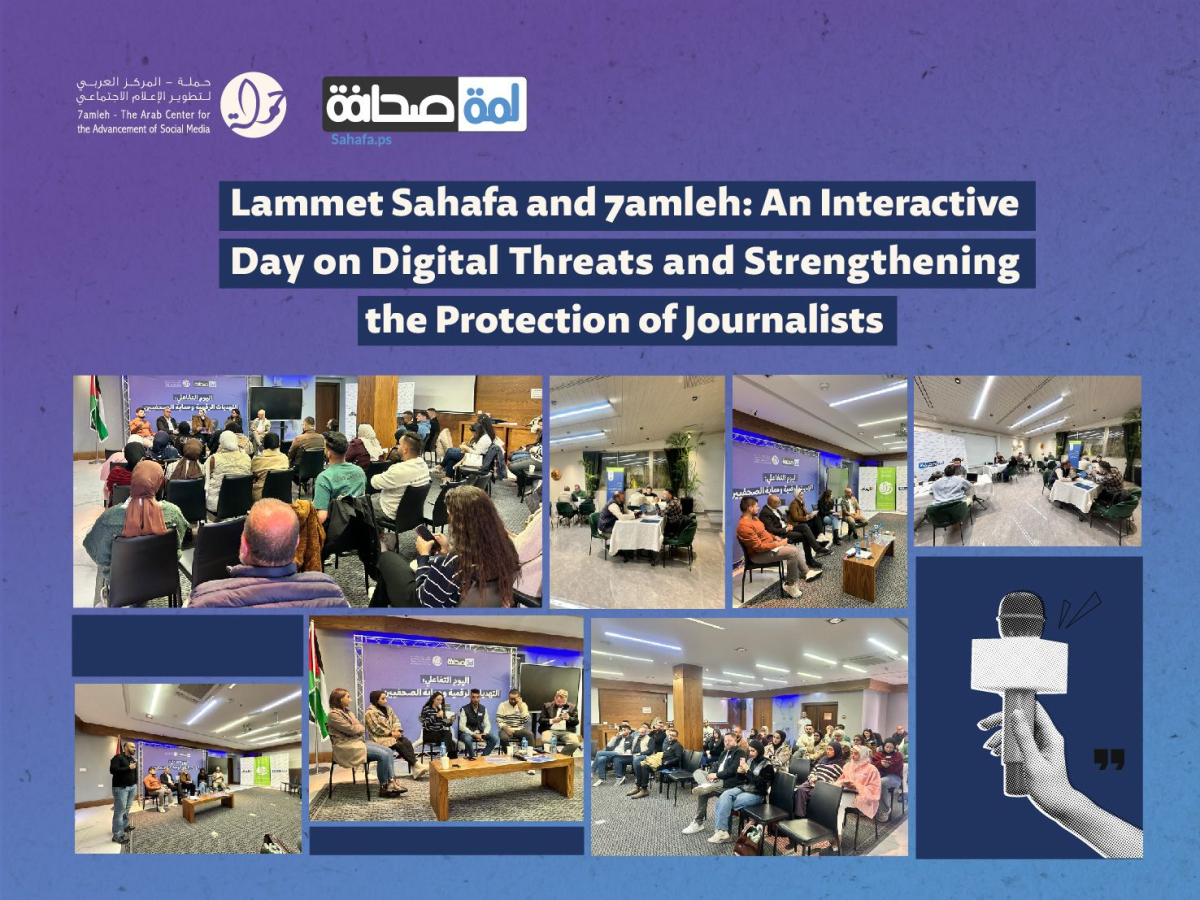
December 8, 2025 - around 45 journalists took part last Tuesday in an interactive day organized in Ramallah by 7amleh - The Arab Center for the Advancement of Social Media, “Lammet Sahafa,” and “Palgraph,” under the title “Digital Threats and the Protection of Journalists.” The event explored the escalating digital threats facing Palestinian journalists, and ways to strengthen digital safety and professional protection, amid an online environment marked by increasing surveillance and targeting.
The interactive day included training sessions and specialized workshops on journalists’ needs in confronting digital threats, priorities for protection, and professional and practical requirements, as well as a panel titled “Digital Security and Confronting Digital Threats Against Journalists.”
The activities also included practical demonstrations delivered by specialized experts from 7amleh, along with detailed guidance on best practices for digital protection, ways to avoid hacks, and how to detect suspicious behavior on devices and accounts. The event further addressed advanced threats, and the role of major digital platforms in restricting Palestinian content and constraining journalistic work.
Ali Obaidat, editor-in-chief of “Palgraph,” stressed that digital challenges have become among the most prominent issues facing Palestinian journalism, noting that digital safety requires organized, long-term efforts, and that the targeting of Palestinian journalists and media outlets through digital platforms has become part of attempts to undermine the Palestinian narrative in the digital sphere.
Journalist Shuruq Al As’ad spoke about the scale of digital violations affecting women journalists, emphasizing that they are among those most exposed to blackmail and digital abuse in various fields, and noting that these violations are severe, systematic, and driven by powerful global actors.
For his part, Ahmad Qadi, Director of the Documentation and Monitoring Unit at 7amleh, affirmed that this interactive day created an important space for direct engagement with journalists and for understanding their real needs in the field of digital safety. He explained that organizing such encounters helps develop more practical and training tools that are closely linked to the realities of daily journalistic work in the Palestinian context.
Journalist Hafez Abu Sabra also noted that Palestinian journalists are targeted in a compounded way in attempts to undermine the Palestinian narrative, explaining that journalists face overlapping forms of surveillance - self, security, and societal - in addition to surveillance by the occupation and global tech companies. This, he stressed, makes it essential for Palestinian journalists to have a deep understanding of all aspects of digital risks and the means to protect themselves.
For his part, Islam Al-Tamimi, Director of Training and Advocacy at the Independent Commission for Human Rights, affirmed that journalists’ digital rights are an integral part of the human rights framework as enshrined in UN resolutions, which have recognized the internet as a human right rather than merely a commercial service, and have guaranteed the right to personal data protection, digital security, and access to information. He noted that human rights organizations are continuously working to pressure for amendments to national legislation, including the 1969 Press and Publications Law and the Cybercrime Law, in order to provide better protection for journalists and those affected by digital rights violations.
The discussions and interactive sessions concluded by stressing the need to adopt modern legislation that protects journalists from digital threats, and to raise awareness of digital safety mechanisms within newsrooms and media institutions, given that the digital space has become an essential part of the journalistic work environment and requires protection parallel to that of the field.
This interactive day comes as part of the efforts of 7amleh, “Lammet Sahafa,” and “Palgraph” to strengthen digital safety for Palestinian journalists and to develop practical and policy responses to the digital threats targeting journalistic work and the Palestinian narrative in the digital sphere.
 Lammet
Related Articles

Subscribe to Our Email Alerts
And stay updated with our latest activities, news, and publications!
