




7amleh and ARIJ Conclude Specialized Training for Palestinian Journalists on Open-Source Investigations
-

-

-

-

 !Copied
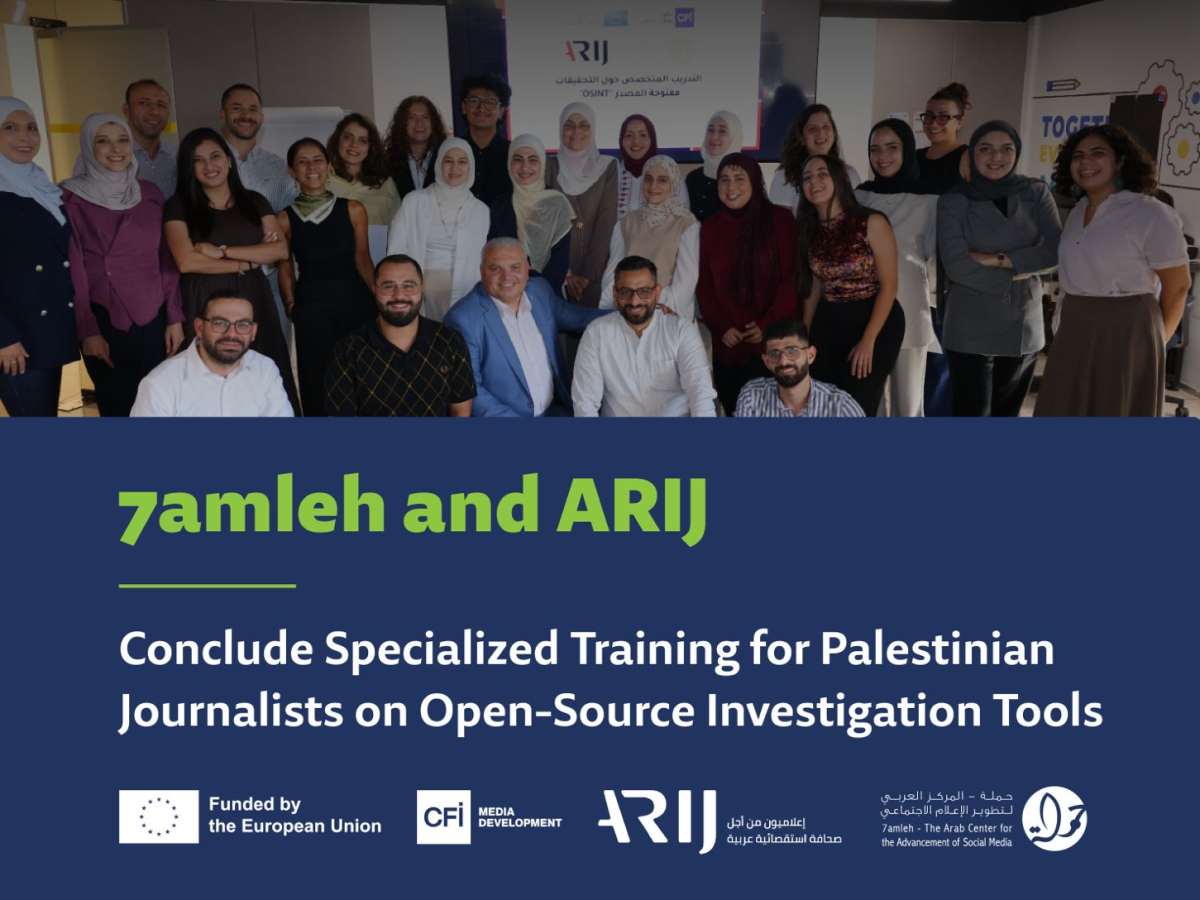
August 9 2026, 7amleh - The Arab Center for the Advancement of Social Media, in collaboration with ARIJ, concluded a specialized training on the use of open-source intelligence (OSINT) tools in journalism and investigative reporting. The training brought together 24 Palestinian journalists from the West Bank and 48 areas, with support from CFI and funding from the European Union.
The three-day training took place from 3 to 5 August 2026 at ARIJ’s offices in Amman, Jordan, with 15 journalists from the West Bank and nine from 48 areas. The program combined theoretical sessions, practical exercises, and discussions, with a focus on methodologies for obtaining information from open sources and the ethical framework governing their use. It also covered practical and advanced tools for verifying news and digital content, tracking and analyzing open-source information, and applying OSINT tools in investigative journalism.
The training was led by E'thar AlAzem, ARIJ Editorial Board Member and Investigations Supervisor, and Fatima Bani Ahmad, ARIJ Senior Fact-Checker. The first day addressed research methodologies using open-source tools, as well as collecting and verifying materials published on social media, including time and location verification and the application of these methodologies to investigations related to war crimes. It also covered searching for and verifying information about individuals using open sources. On the second day, participants explored methodologies for tracking financial flows and corporate activities, using open and commercial databases, and searching public records.
The third day covered concepts and methodologies for investigating disinformation campaigns, as well as approaches to monitoring, collecting, and analyzing data and tracking vessels and aircraft. The program emphasized practical application and connecting tools and methodologies to real-world journalistic contexts, enabling participants to apply them systematically and accurately in developing their investigations and reports.
Commenting on the training, Ahmad Qadi, Monitoring and Documentation Manager at 7amleh and the training coordinator, said: “The importance of the training went beyond learning tools and methodologies. It also provided an opportunity for Palestinian journalists from different geographic areas to meet, connect, and learn together. This diversity and shared space open opportunities to build relationships and collaborations that can continue beyond the training, and we hope to build on this experience in our future work.”
Rawan Damen, Director General of ARIJ, emphasized the importance of an institutional environment that allows for discussion, fact-checking, and professional disagreement as an integral part of investigative journalism. She noted that the true value of the training lies in participants’ ability to transfer the knowledge and skills they gained to their institutions and apply them in their investigations and journalistic work.
Participants’ feedback highlighted the importance of creating such spaces for Palestinian journalists, particularly amid the pressures of fast-paced, daily news coverage. One participant said: “The pressure of daily work, especially over the past three years, has taken us away from in-depth reporting and investigative journalism, because we are constantly dealing with breaking news and unfolding events. Trainings like this give us space to pause, refocus, and return with new ideas and renewed motivation to produce in-depth investigations and quality reporting.”
Other participants noted that the training exceeded their expectations in terms of the amount of information covered and the depth achieved within a short period, particularly through practical exercises and exposure to new tools. Others highlighted how the training strengthened their understanding of accessing and handling information, as well as the importance of accuracy, confidentiality, and verification in journalistic and investigative work.
The training forms part of 7amleh’s ongoing efforts to strengthen the capacities of Palestinian journalists to navigate an evolving digital environment, develop their skills in accessing, verifying, and analyzing information, and enhance the use of digital tools and methodologies in producing professional, in-depth journalism. Bringing together journalists from the West Bank and 48 areas also created a space for networking, exchanging experiences, and building professional relationships that can support future collaboration.
 7amleh
Related Articles
Subscribe to Our Email Alerts
And stay updated with our latest activities, news, and publications!
