




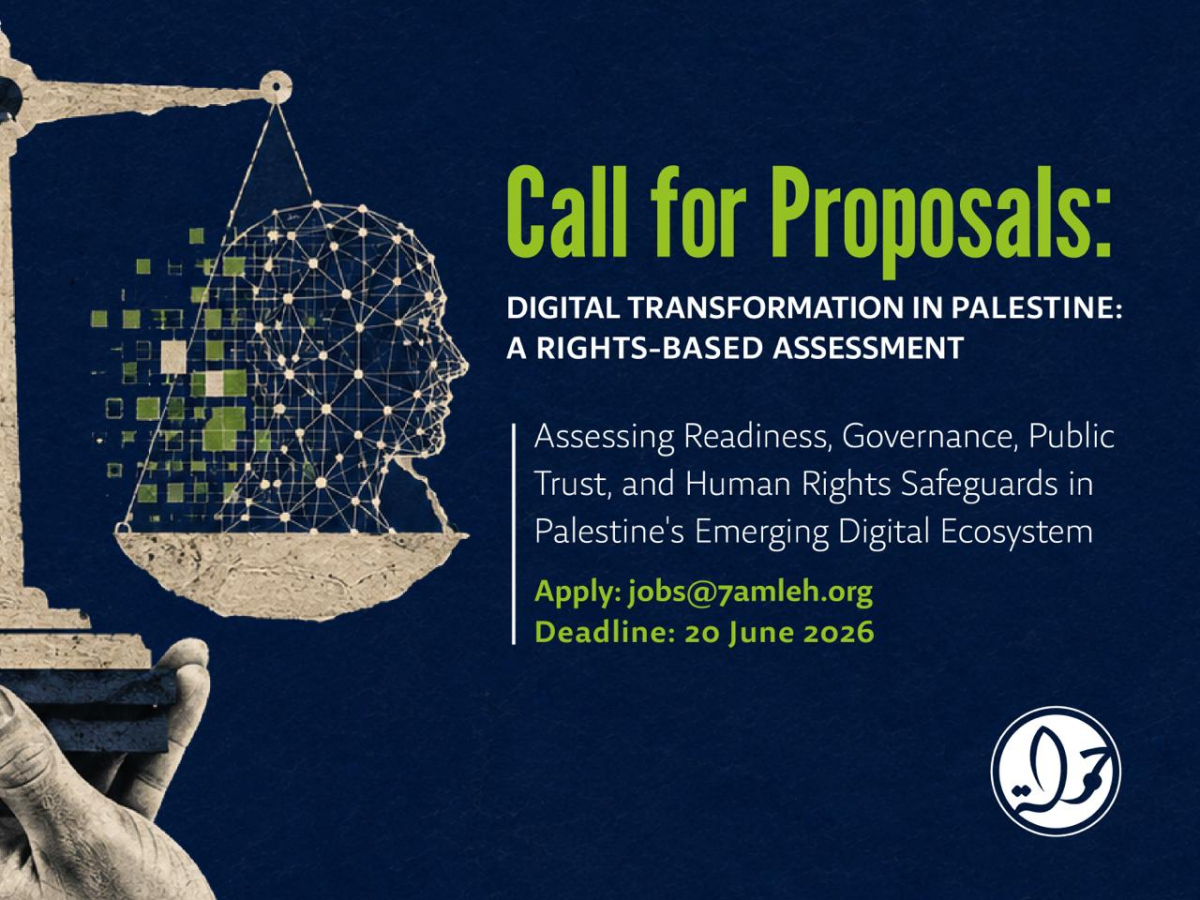
Digital Transformation in Palestine: A Rights-Based Assessment
-

-

-

-

 !Copied
Terms of Reference and Scope of Services
Digital Transformation in Palestine: A Rights-Based Assessment
Assessing Readiness, Governance, Public Trust, and Human Rights Safeguards in Palestine's Emerging Digital Ecosystem
Background
Palestine is entering a decisive phase in its digital transformation. Government institutions, development partners, international organizations, and private-sector actors are increasingly investing in initiatives related to digital public services, digital identity systems, interoperable data infrastructures, financial technologies, and emerging artificial intelligence applications.
These developments are often framed as essential tools for improving efficiency, expanding service delivery, promoting financial inclusion, and strengthening institutional resilience. Major initiatives currently under discussion or implementation include digital government services, digital identity solutions, data-sharing systems, and broader efforts to modernize public administration through technology.
At the same time, digital transformation in Palestine is taking place within a complex political, legal, and technological environment. Telecommunications infrastructure remains constrained by the realities of occupation and, in Gaza, has been subjected to widespread destruction. Important legal frameworks, including legislation relating to personal data protection and access to information, remain incomplete or unenforced. Concerns relating to privacy, surveillance, freedom of expression, public trust, and accountability continue to shape public perceptions of digital governance initiatives.
While significant attention is being devoted to digital transformation, there remains a need for an independent Palestinian assessment that examines these developments through a human rights lens and evaluates whether the necessary legal, institutional, and governance foundations are in place to support an inclusive, trusted, and rights-respecting digital future.
Objective
The overall objective of this research is to assess Palestine's readiness for digital transformation through a human rights lens. The assessment will examine the legal, institutional, technical, and governance foundations underpinning current and emerging digital transformation initiatives and evaluate the extent to which they align with principles of privacy, transparency, accountability, inclusion, freedom of expression, and public participation.
The research aims to generate evidence-based analysis and recommendations that can inform policymakers, civil society organizations, development partners, and private-sector actors working on digital transformation initiatives in Palestine.
Research Questions
The assessment should seek to answer the following key questions:
-
What are the principal digital transformation initiatives currently being pursued in Palestine by government institutions, private-sector actors, and international development partners?
-
To what extent is Palestine's existing digital and telecommunications infrastructure capable of supporting large-scale digital transformation initiatives?
-
What institutional capacities, governance mechanisms, and public-sector arrangements currently exist to oversee digital transformation efforts?
-
To what extent do existing laws, policies, and regulatory frameworks provide adequate safeguards for privacy, data protection, transparency, access to information, and digital rights?
-
What legislative and policy gaps remain unaddressed in relation to digital identity systems, data governance, artificial intelligence, and emerging technologies?
-
What are the potential implications of digital transformation initiatives for privacy, freedom of expression, access to information, non-discrimination, and civic participation?
-
How do concerns relating to surveillance, accountability, transparency, and public trust affect the adoption and governance of digital systems?
-
What safeguards, reforms, and governance mechanisms are necessary to ensure that digital transformation advances public benefit while respecting human rights?
Methodology
The research shall adopt a mixed-methods approach combining desk research, stakeholder consultations, and policy analysis.
The researcher shall review:
-
Palestine's National Digital Strategy and related policy frameworks.
-
Government initiatives relating to digital identity, digital public services, financial technologies, interoperability frameworks, and emerging AI initiatives.
-
Existing Palestinian legislation and draft legislation relevant to digital transformation, including:
-
Telecommunications-related legislation.
-
Cybercrime legislation and proposed amendments.
-
Draft Personal Data Protection legislation.
-
Draft Access to Information legislation.
-
Electronic Transactions legislation.
-
Relevant reports and publications issued by civil society organizations, international organizations, development agencies, academic institutions, and private-sector actors.
-
International standards and best practices relating to digital governance, privacy, data protection, AI governance, and digital rights.
The researcher shall conduct approximately 10 semi-structured interviews with relevant stakeholders, which may include the Ministry of Telecommunications and Digital Economy, Palestine Monetary Authority, Telecommunications and technology companies, and relevant government or private institutions involved in digital transformation.
The assessment shall evaluate digital transformation efforts against internationally recognized human rights principles, including privacy and data protection, freedom of expression, access to information, transparency and accountability, non-discrimination and inclusion, and civic participation and public oversight.
Expected Output
The final report (4,000–5,000 words) should include:
1. Executive Summary.
2. Overview of the Digital Transformation Landscape.
3. Assessment of Infrastructure and Institutional Readiness.
4. Review of existing and proposed legislation relevant to digital transformation and digital rights.
5. Analysis of Implications on Digital Rights.
6. Identification of Key Gaps.
7. Targeted Recommendations.
Timeline
|
Activity |
Timeline |
|
ToR and Researcher selection |
June 2026 |
|
Delivery of Inception Report |
15 July 2026 |
|
First Draft Submission |
15 August 2026 |
|
Feedback and Revisions |
August–September 2026 |
|
Final Report Submission |
15 September 2026 |
Required Qualifications
The ideal candidate should possess
-
An advanced degree in law, public policy, digital governance, technology policy, human rights, or a related field.
-
Demonstrated experience conducting policy, legal, or governance research.
-
Knowledge of digital rights, privacy, data governance, AI governance, or digital transformation.
-
Familiarity with the Palestinian political, legal, and technological context.
-
Strong analytical and writing skills.
Submission of Proposals
Interested researchers or research teams are invited to submit a price offer/proposal, including a brief background, relevant samples of previous work, and a CV or organizational profile.
Please send your proposal to Jobs@7amleh.org, citing “Rights-Based Assessment of Digital Transformation” in the subject line, by June 20, 2026.
 Digital
Related Articles







Subscribe to Our Email Alerts
And stay updated with our latest activities, news, and publications!
