




New 7amleh Report: Palestinian Exclusion from the Digital Economy is Structural and Systematic
-

-

-

-

 !Copied
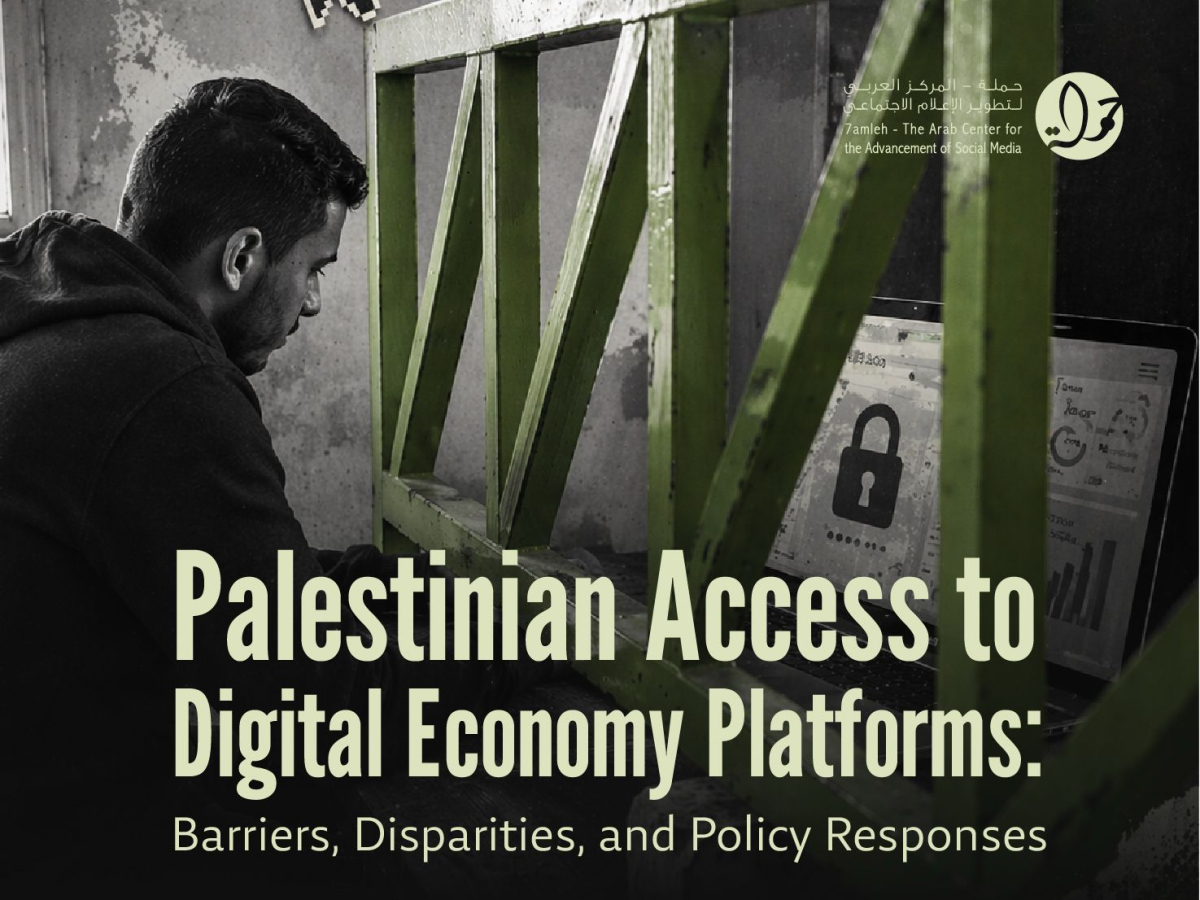
May 5, 2026, 7amleh - The Arab Center for the Advancement of Social Media released a new report titled “Palestinian Access to Digital Economy Platforms: Barriers, Disparities, and Policy Responses.” The report highlights the systematic exclusion Palestinians face in accessing global digital platforms, including payment services, e-commerce, and remote work platforms.
The report is based on an analytical methodology that examined around 30 major digital services across payment, e-commerce, and online work categories in Gaza, the West Bank, and Israel. For each platform, the researcher attempted to create and verify an account and access core functions using locally available internet connections, devices, and payment instruments, while documenting geographic restrictions, terms of service, and user experience barriers.
The report finds that Palestinians in the West Bank, Gaza Strip, and inside Israel face structural barriers that restrict their participation in the digital economy. These barriers are shaped by the intersection of global tech company policies and Israeli control over ICT infrastructure, limiting access to essential economic tools.
Digital payment services constitute one of the most significant barriers. Palestinians in the West Bank and Gaza are excluded from global platforms such as PayPal and Payoneer, while these services remain available to Israeli citizens, including settlers in the West Bank. This exclusion prevents Palestinians from receiving payments or managing digital businesses normally, forcing them to rely on costly, insecure, and unstable alternatives.
The report also documents major connectivity disparities. Palestinians in the West Bank remain limited to 3G services, while Gaza remains largely limited to 2G, compared to 4G and 5G networks in Israel. These infrastructure inequalities directly undermine remote work and e-commerce participation.
In e-commerce, the report shows that Palestinians face unequal treatment in shipping and access to global markets, including discriminatory policies on platforms such as Amazon and eBay, where settlements receive service privileges while Palestinians face restrictions and additional costs. In online freelancing, although Palestinians can access platforms such as Upwork and Fiverr, income generation remains heavily constrained by financial and infrastructural barriers, causing workers to lose significant portions of their earnings to intermediaries and commissions.
The report stresses that these practices cannot be understood as merely technical or procedural obstacles, but as part of a wider system of digital and economic exclusion that directly restricts Palestinians’ ability to participate in the global economy.
Jalal Abukhater, Policy Manager at 7amleh, said: “The exclusion of Palestinians from digital economy platforms is the result of discriminatory policies and systems of control. What is needed is accountability for technology companies and fair access for Palestinians to essential digital economic tools.”
The report concludes that Palestinian digital exclusion is structural, produced by the interaction between technology policies and the political and economic context. It calls for this exclusion to be addressed as both a digital rights and economic rights issue.
Accordingly, 7amleh calls for an end to discriminatory service policies by global tech companies, expanded Palestinian access to digital payment services, and the removal of restrictions on Palestinian ICT infrastructure to ensure more equitable participation in the global digital economy. 7amleh also stresses the need to enhance financial and digital inclusion and support sustainable local alternatives as essential steps toward protecting Palestinians’ digital and economic rights.
To read the full report, visit the link here.
 7amleh
Related Articles




Subscribe to Our Email Alerts
And stay updated with our latest activities, news, and publications!
