




New Report Examines the Role of EU Funding and Export of High-Risk AI Systems in Escalating Human Rights Violations in Palestine and the Region
-

-

-

-

 !Copied
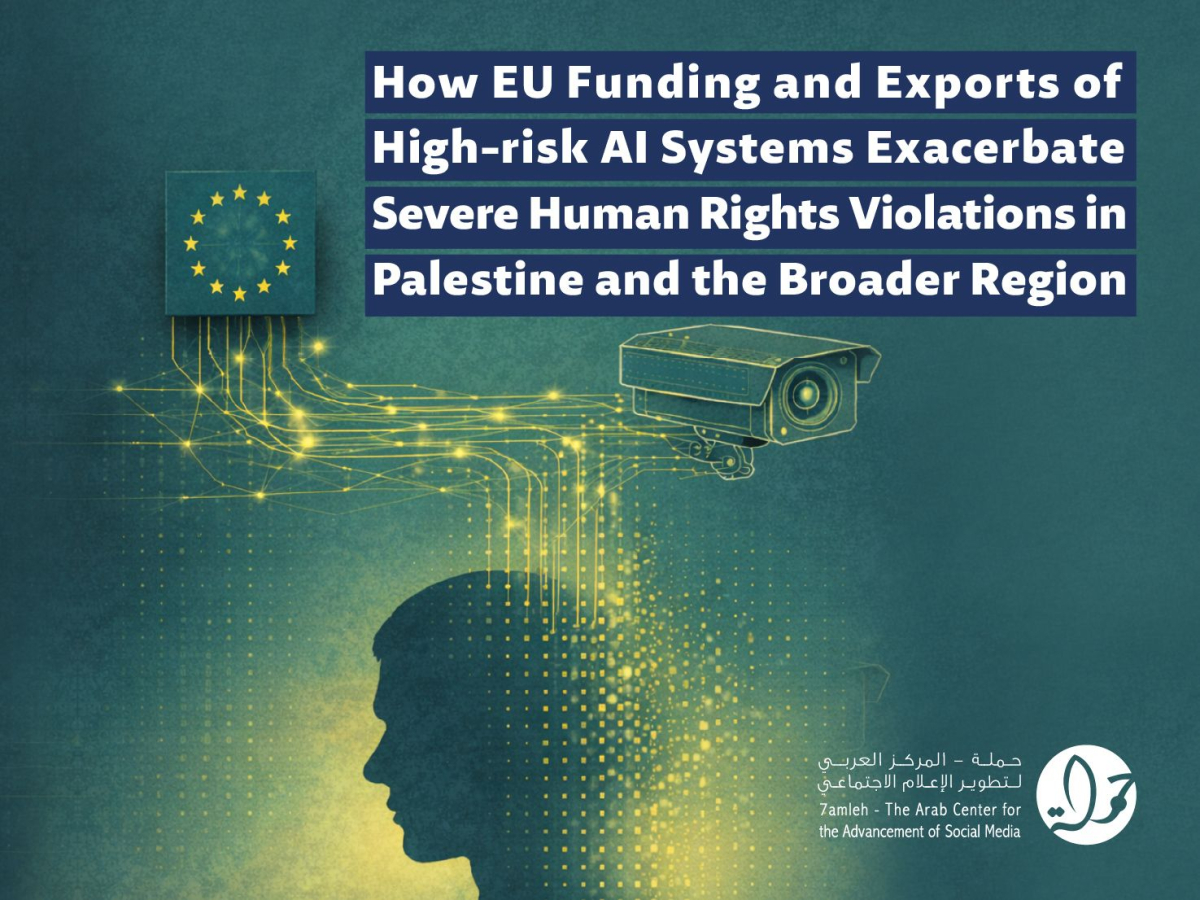
March 16, 2026, 7amleh – The Arab Center for the Advancement of Social Media has released a new report titled “How EU Funding and Exports of High-risk AI Systems Exacerbate Severe Human Rights Violations in Palestine and the Broader Region.” The report provides an in-depth analysis of how European policies contribute to financing and exporting advanced digital technologies used in contexts of surveillance, control, and repression, including in the occupied Palestinian territory and countries across the Middle East and North Africa.
The report shows that the European role does not end with developing regulatory frameworks for artificial intelligence within its own borders. Through funding programs, investment mechanisms, and technology exports, the EU also supports the spread of high-risk systems abroad, where they are used in areas such as migration management, biometric surveillance, predictive security systems, and data analysis. In the absence of strong safeguards and oversight, these technologies contribute to deepening violations related to freedom of expression, privacy, freedom of movement, and political participation.
The report identifies three main pathways through which these technologies reach the region. The first involves EU-funded migration management programs that rely on advanced surveillance technologies, including biometric identification systems and risk-analysis tools. The second involves financial and research support for Israeli weapons and technology companies that develop AI-based tools used in military operations and surveillance systems. The third involves the export of high-risk AI systems by European companies, including facial recognition technologies, smart-city systems, and digital surveillance infrastructures.
The report highlights that these technologies operate within highly sensitive political and security contexts, increasing the risk of violations of fundamental rights. Palestinians are subjected to AI-driven surveillance systems embedded within a broader architecture of digital control that enables Israeli authorities to track and monitor their movements, affecting freedom of movement, daily life, and access to essential services. The report also notes that some of these technologies were developed or financed through European research and innovation programs or through defense and investment funding mechanisms.
The report warns that continued funding and export of such systems, in the absence of transparency, independent oversight, and adequate human rights due diligence, expands the surveillance and repression capacities of governments and military actors. It also exposes journalists, activists, and human rights defenders to increasing risks of monitoring and targeting. The report further highlights legal loopholes that allow European companies to export technologies classified as high-risk—or even prohibited within the EU—to countries outside its borders without sufficient safeguards to prevent human rights abuses.
The report concludes that current European policies on funding, innovation, and technology exports raise serious questions regarding the EU’s commitment to human rights principles in its external actions, particularly when these activities intersect with armed conflicts or authoritarian governance systems.
Read the full report, by clicking here.
 Report
Related Articles







Subscribe to Our Email Alerts
And stay updated with our latest activities, news, and publications!
