




7amleh Releases New Position Paper: Visual Violence as a Tool of Humiliation and Domination over Palestinian Youth
-

-

-

-

 !Copied
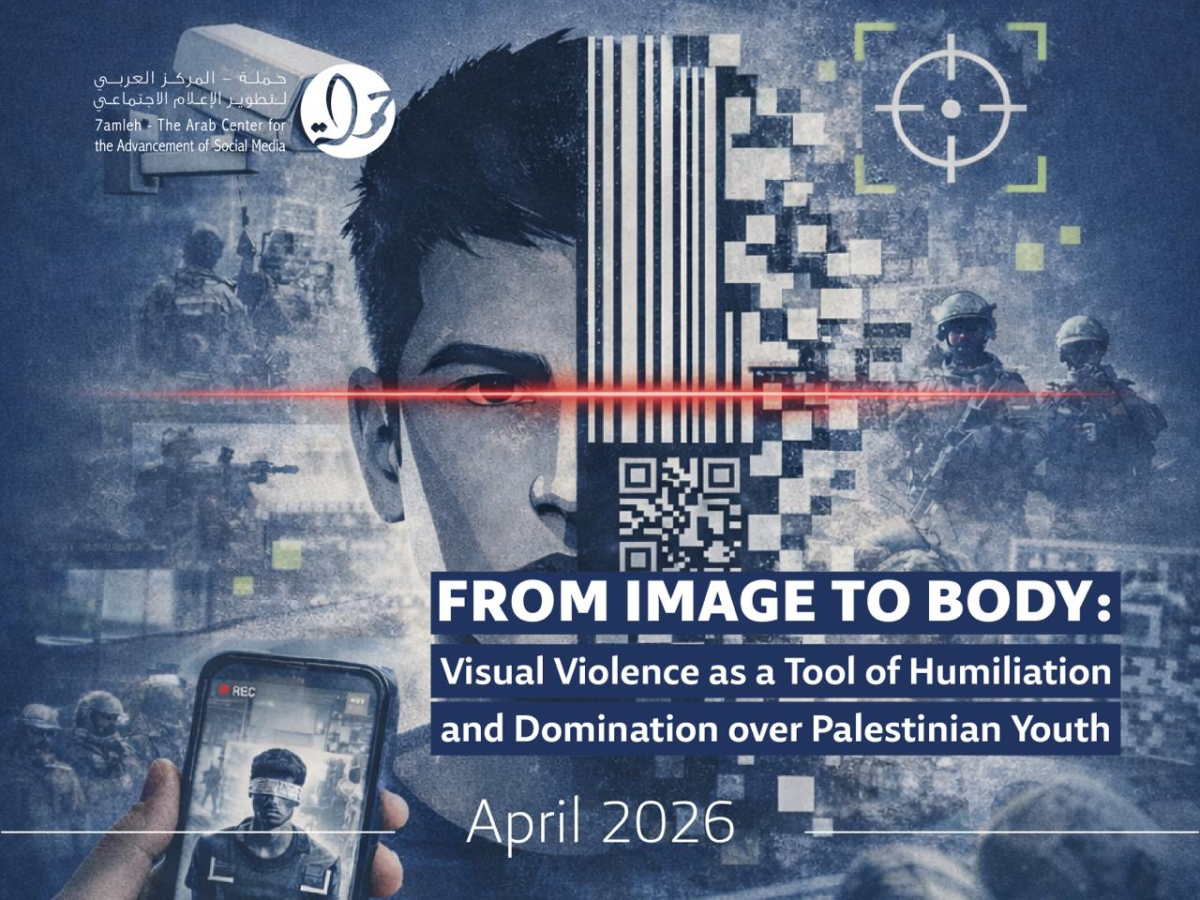
April 20, 2026, 7amleh - The Arab Center for the Advancement of Social Media has released a new position paper titled “From Image to Body: Visual Violence as a Tool of Humiliation and Domination over Palestinian Youth.” The paper highlights the rise of visual violence practiced by the Israeli occupation army through documenting violations and abuses against Palestinians and publishing them on social media platforms, transforming them into public spectacles of humiliation, mockery, and domination. It shows that these practices have particularly targeted Palestinian youth across the West Bank, including East Jerusalem, and the Gaza Strip, as the most visible group in digital spaces and the most exposed to arrest, searches, and visual surveillance under occupation.
The paper argues that these practices cannot be understood as isolated incidents or byproducts of war, but rather as a structural pattern where imagery intersects with violence and power. In these contexts, images do not function as tools of documentation or accountability, but as a direct extension of the violation itself. Forced photography and the circulation of degrading images are used to control the Palestinian body, strip it of its humanity, and transform it into a visual object for display and circulation without consent.
The paper documents a wide range of violations, including photographing detainees while stripped, documenting sexual violence and invasive searches in prisons and at checkpoints, filming home raids and takeovers, and capturing scenes of killing and destruction. It also highlights the circulation of videos showing soldiers celebrating or dancing to racist songs calling for violence. These materials are not marginal; they have been widely shared and praised by Israeli users, turning violence into normalized, consumable content.
The paper emphasizes that the impact of visual violence extends far beyond the moment of capture or publication, producing deep psychological, social, and political effects, including digital trauma, the erosion of social solidarity, the distortion of collective memory, and the numbing of ethical sensitivity among audiences.
It also examines the structural dimension of visual violence through biometric surveillance systems used by Israeli authorities in the West Bank, including East Jerusalem, and Gaza. These include facial recognition technologies and military applications that turn Palestinian bodies into data—subject to tracking, classification, restriction, and control. The paper shows how these systems not only monitor but also reproduce control over Palestinians in both public and private spaces, reinforce self-censorship, and undermine social and political life, particularly for youth.
The paper further finds that such practices violate digital and human rights, including the rights to privacy, digital dignity, and protection from degrading and inhumane treatment. These violations also contravene international legal frameworks, including the Fourth Geneva Convention (1949), which prohibits exposing individuals to public curiosity through the dissemination of images or personal data. In this context, the paper stresses that the act of photographing itself constitutes a violation, not merely documentation of one.
The paper concludes that visual violence is not peripheral to war, but embedded within it, and operated through cameras, reinforced by platforms and algorithms, and reproduced through social normalization. Addressing this phenomenon therefore requires going beyond treating images as documentation, to include accountability for perpetrators, restricting the circulation of visual violence, and protecting victims from repeated exposure.
Accordingly, 7amleh calls for increased legal and international pressure to end the use of photography and biometric surveillance as tools of control against Palestinians. It urges technology companies to remove visual content that documents the humiliation and abuse of Palestinians, beyond narrow content-moderation standards. It also calls for the establishment of dedicated monitoring mechanisms for visual violence, the recognition of photographing, publishing, or threatening to publish such content as a standalone crime in legal proceedings, and the development of psychosocial support programs for Palestinian youth affected by digital trauma. Additionally, it calls for awareness campaigns and a Palestinian ethical code to regulate the circulation of violent visual content in ways that protect victims’ dignity and prevent the reproduction of harm.
To read the full position paper, visit the link here.
 7amleh
Related Articles
Subscribe to Our Email Alerts
And stay updated with our latest activities, news, and publications!
