



Hashtag Palestine 2025: Digital Repression as a System Governed by Law, Political Pressure, and Algorithms
-

-

-

-

 !Copied
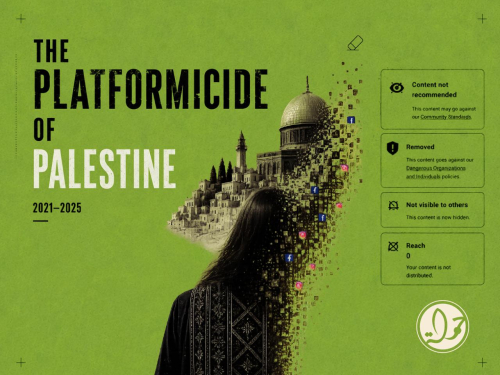
February 18, 2026, 7amleh - The Arab Center for the Advancement of Social Media has released its annual report, Hashtag Palestine 2025, offering an in-depth analysis of how Palestinian digital rights are being restricted through an interconnected system that combines government policies, platform governance, and emerging technologies amid ongoing crises, war, and grave human rights violations.
The report concludes that what Palestinians face is no longer limited to the removal of a post or the suspension of an account. Rather, it has evolved into a “structure of control” that integrates legislation, digital policing, cross-border political pressure, automated enforcement, and AI-powered surveillance. This system restricts freedom of expression, reinforces self-censorship, and systematically excludes Palestinian voices from the digital public sphere.
Throughout 2025, the report documents a total of 3,452 digital violations against Palestinians and their supporters. The findings are based on monitoring, literature review, documented case studies, and data collected through “7or” – the Palestinian Digital Rights Observatory. The analysis identifies recurring patterns of repression, including content censorship, incitement and hate speech, targeting and harassment, as well as restrictions on digital access and exclusion from digital economy platforms, deepening vulnerability and inequality.
Regarding platform censorship, 7amleh received 538 censorship complaints through the “7or” platform during the year, including content removal, account suspensions, restrictions, warnings, and reduced visibility. The report also documents 2,910 manually submitted cases involving violations such as hate speech and incitement. These figures reflect the scale of sustained harm experienced by Palestinians in digital spaces, not as incidental outcomes, but as direct consequences of unequal policies and enforcement practices.
Additionally, data from 7amleh’s Violence Indicator, which uses AI tools to monitor violent posts, shows that in 2025 there were 125,947 violent and inciting posts in Hebrew targeting Palestinians, nearly 90% of which were concentrated on platform X.
The report highlights a dangerous contradiction in platform governance: the disproportionate silencing of Palestinian voices alongside tolerance—and at times amplification—of racist and dehumanizing content. A particularly alarming example involves government pressure channeled through U.S.-based technology companies, resulting in YouTube’s permanent removal of the channels of three Palestinian human rights organizations (Al-Haq, Al Mezan Center for Human Rights, and the Palestinian Centre for Human Rights) and the deletion of over 700 videos documenting alleged war crimes. This erasure of evidentiary material undermines access to truth and accountability.
Digital repression also extends beyond freedom of expression to the right to life and survival, including the obstruction of financial support mechanisms. The report notes that platforms such as GoFundMe blocked or froze humanitarian fundraising campaigns related to Gaza, preventing access to medical care, emergency supplies, and life-saving assistance—reflecting what the report terms “digital discrimination” that intensifies in conflict zones. It further emphasizes that internet restrictions, the destruction of telecommunications infrastructure, and continued exclusion from the digital economy collectively undermine resilience.
The report also examines the close relationship between major technology companies and Israeli military and intelligence bodies, highlighting the role of cloud services, AI systems, data analytics, and spyware in facilitating surveillance, targeting, and censorship. It argues that claims of “neutrality” do not withstand evidence of ongoing partnerships and profit-driven expansion into military and security applications. The report warns that Gaza risks becoming a “testing ground” for AI-assisted warfare, with devastating consequences for civilians and civilian infrastructure.
In response, 7amleh stresses that addressing these violations requires more than technical or procedural reforms—it demands rights-based and binding accountability measures. The report calls on social media platforms and technology companies to simplify reporting mechanisms, ensure timely responses, allocate context-sensitive regional expertise, provide full transparency regarding content moderation, government requests, and automated systems, guarantee the right to explanation and appeal, and avoid one-size-fits-all policies that perpetuate discrimination.
It also urges civil society and international actors to take immediate action to halt systematic violations and establish accountability mechanisms, including for attacks on telecommunications infrastructure, and to strengthen compliance with international human rights standards in the enforcement of digital legislation with cross-border impacts.
To read the full report, visit the link here.
 Hashtag
Related Articles
Subscribe to Our Email Alerts
And stay updated with our latest activities, news, and publications!
