




New 7amleh Study Examines the Role of TikTok’s Algorithms in Reproducing Organized Crime Culture within Palestinian Society in Israel
-

-

-

-

 !Copied
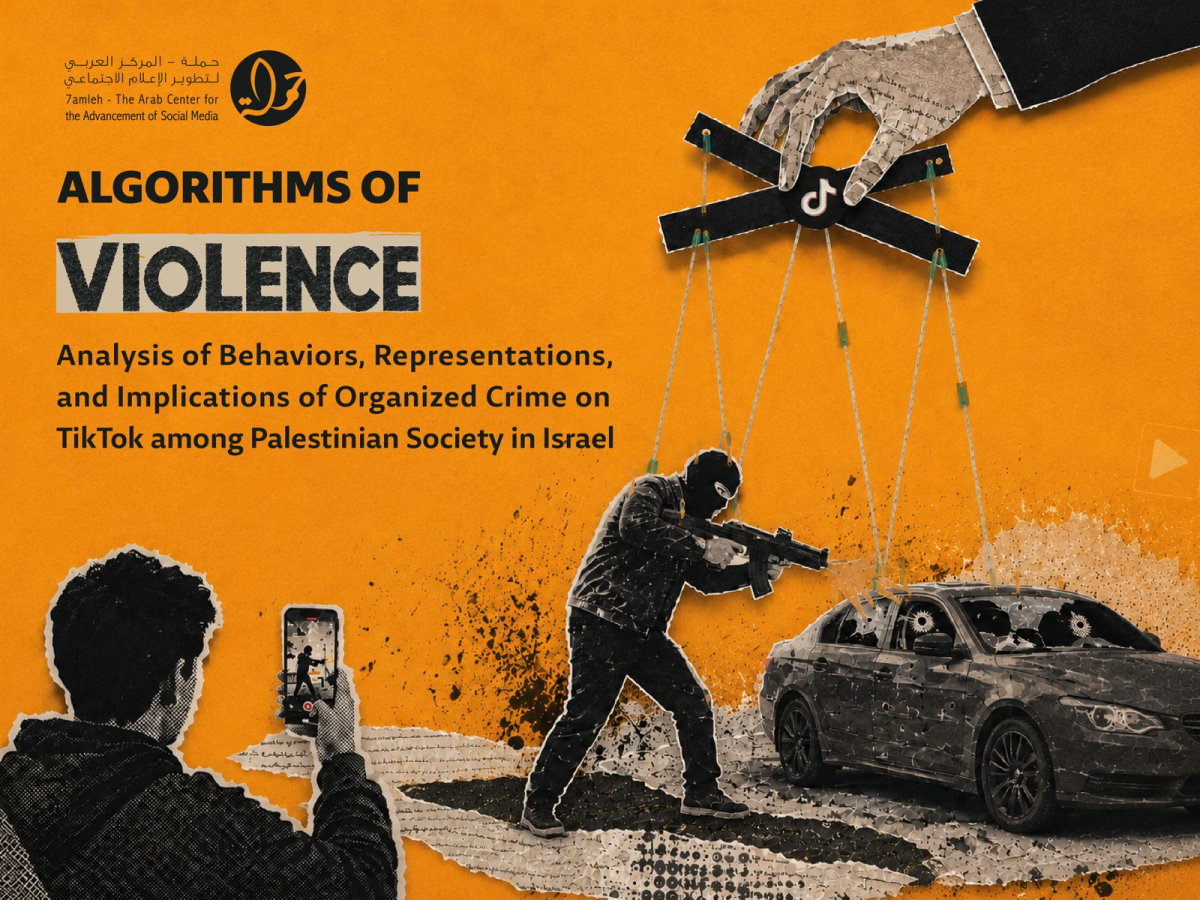
July 20, 2026, 7amleh - The Arab Center for the Advancement of Social Media has launched a new study titled "Algorithms of Violence: Analysis of Behaviors, Representations, and Implications of Organized Crime on TikTok among Palestinian Society in Israel." The study examines the relationship between the prevalence of organized crime and the increasing presence of criminal actors on TikTok, and explores the implications of this phenomenon for young people and Palestinian society in Israel.
The study concludes that, beyond serving as a platform for entertainment and content sharing, TikTok has, in many cases, become a space exploited by organized crime networks to reproduce violence, construct criminal identities, display power and influence, and communicate with audiences. These practices contribute to the normalization of criminal behavior and strengthen its presence within the digital space.
The research employed a mixed-methodology approach combining interviews with criminologists and digital media specialists, a focus group with professionals working with youth, and an AI-powered model developed by 7amleh to analyze videos, images, and text, and detect violence-related content across digital platforms. The model was applied to a sample of crime-related content published on TikTok.
The findings reveal that criminal organizations use TikTok for purposes that extend beyond sharing violent footage. These include promoting criminal identity, showcasing weapons, money, and luxury vehicles, issuing threats and intimidation, promoting illegal activities, and recruiting new members while expanding their influence within society. The study further finds that TikTok's algorithms, which prioritize highly engaging and attention-grabbing content, contribute to amplifying the spread of such content, particularly among young users.
The study warns that repeated exposure to this content may normalize violence, reduce sensitivity toward crime, reinforce the image of offenders as symbols of power, and increase the likelihood that some young people will imitate or engage in similar behaviors. At the same time, it emphasizes that this phenomenon cannot be understood in isolation from broader structural factors, including marginalization, exclusion, weakened protection systems, and Israel's discriminatory policies toward Palestinian society in Israel.
Commenting on the findings, Ahmad Qadi, Monitoring and Documentation Manager at 7amleh, said: "This study demonstrates that social media platforms are no longer merely spaces for sharing content; they have become part of the digital environment that may contribute to amplifying and reproducing violence when content moderation policies and algorithmic systems fail to limit its spread. Technology companies therefore have a responsibility that extends beyond removing violating content. They must also develop more effective mechanisms to limit the spread of criminal content and better protect users, particularly young people."
The study calls on TikTok to develop more effective mechanisms for detecting and removing criminal content, increase transparency around its moderation policies, and reduce algorithmic recommendations of violent and criminal content. It also recommends a comprehensive response involving educational institutions, civil society organizations, the media, families, and decision-makers to address both the structural roots of the phenomenon and its digital dimensions.
7amleh emphasizes that addressing the exploitation of digital platforms by organized crime networks requires cooperation between technology companies and community institutions, alongside investment in digital awareness programmes, media literacy, and safe and positive digital alternatives for young people, contributing to a safer digital space for Palestinian society in Israel.
The full study is available here.
 7amleh
Related Articles
Subscribe to Our Email Alerts
And stay updated with our latest activities, news, and publications!
