




Civil Society Coalition Demands Addressing Digital Repression in MENA at UN Human Rights Council (HRC61)
-

-

-

-

 !Copied
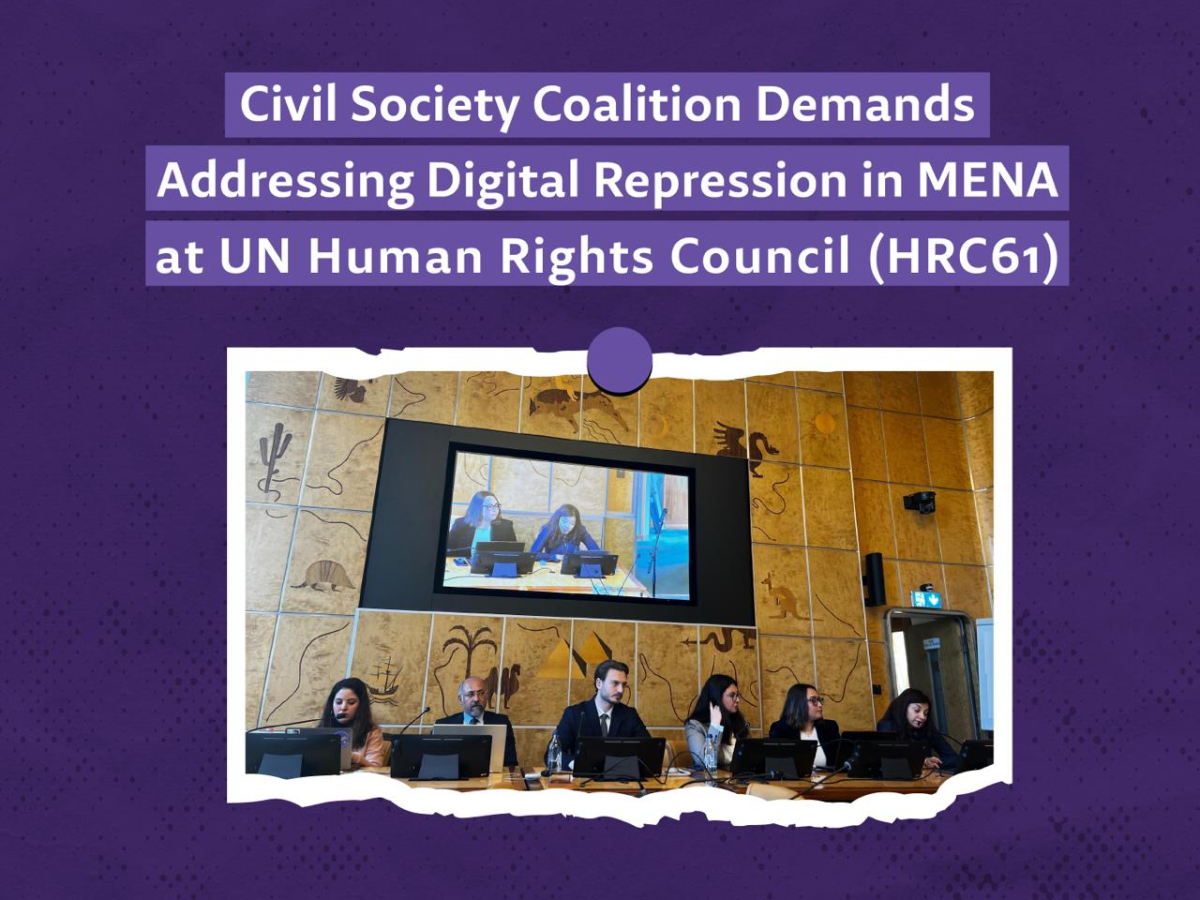
During the 61st session of the UN Human Rights Council in Geneva, 7amleh – The Arab Center for the Advancement of Social Media – participated in a joint regional advocacy mission to advance digital rights, protect civic space, and strengthen international attention to digital repression and technology-enabled human rights violations across the Middle East and North Africa. The mission was led by Innovation for Change MENA Hub in partnership with 7amleh, alongside participating organizations HuMENA for Human Rights and Civic Engagement, SmarGov, and Wasl for Human Rights Tunisia.
Held from 25 to 27 February 2026, the mission formed part of the Digital Democracy Initiative in MENA and aimed to bring regional evidence, policy recommendations, and lived realities into international human rights discussions. It sought to reframe digital repression not as a secondary technology issue, but as a core democratic governance and human rights issue affecting civil society actors, journalists, human rights defenders, and communities across the region.
For 7amleh, this mission was also a key opportunity to push more forcefully on questions of tech accountability and corporate responsibility, especially in relation to Palestine and the broader region. Our engagement highlighted the role of digital platforms and technology companies in shaping rights outcomes through discriminatory moderation, lack of transparency, weak human rights due diligence, and failures to address incitement and harm. We also stressed the urgent need for greater scrutiny of surveillance technologies, spyware, biometric systems, and other high-risk and dual-use technologies that are deployed against communities without adequate safeguards or accountability.
A central moment of the mission was the side event, “Digital democracy under attack: civic space, surveillance, and online repression in MENA,” which served as a public platform to present evidence-based analysis, regional trends, and lived experiences directly to diplomats, UN officials, and international civil society actors. The event addressed the growing convergence of surveillance, online repression, legal harassment, and platform-based restrictions as tools used to suppress dissent and shrink civic space in the region.
Across the mission, the coalition documented patterns of abuse including the weaponization of cybercrime and counterterrorism laws, misuse of false information provisions, unlawful digital surveillance, spyware, biometric technologies, internet shutdowns, judicial harassment, and transnational repression targeting activists in exile. These interventions were brought into bilateral meetings with Permanent Missions, UN Special Procedures, and other international stakeholders, with the aim of securing stronger international engagement and follow-up.
From 7amleh’s perspective, these discussions also connected directly to wider concerns around technology-enabled repression on Palestinians, including attacks on telecommunications infrastructure, restrictions on access to information, digital censorship, surveillance, and the use, export, and funding of high-risk systems. This includes growing concerns around dual-use technologies, drones, AI-enabled systems, and other forms of corporate and state complicity that demand stronger scrutiny under international human rights standards. 7amleh’s advocacy called for closing legal and regulatory gaps that allow surveillance and high-risk AI harms against Palestinians, including harms linked to exports and external deployment, and for stronger safeguards where serious violations are likely.
The coalition’s recommendations to Permanent Missions also called for stronger protections for digital civic space, independent oversight of surveillance practices, reform of abusive cybercrime frameworks, and accountability for technology-enabled repression. In the case of Palestine, this included calls to halt facial recognition and other biometric surveillance practices and to ensure investigation and accountability for spyware attacks targeting Palestinian human rights defenders and civil society actors.
This Geneva mission was not a standalone moment. It was part of a broader regional effort to build collective advocacy, secure international endorsements, and push for a more rights-based and accountable approach to digital governance in the MENA region. For 7amleh, it was also an important space to continue advancing work on Palestinian digital rights, corporate accountability, and the human rights impact of high-risk technologies, including surveillance systems, drones, and dual-use tools enabled through international funding and export structures.
 Civil
Civil
Related Articles



Subscribe to Our Email Alerts
And stay updated with our latest activities, news, and publications!
