!Copied
About this publication
New 7amleh Report Documents Online Incitement Against Palestinian Olive Harvesters
16 November 2026, 7amleh - The Arab Center for the Advancement of Social Media released a new report titled "Harvest of Incitement: Hebrew Violent Content On Facebook Against Palestinian Olive Harvesters". The report documents an overlap between online targeting and violence on the ground. Settler attacks or disruptions to the olive harvest were reported in four of the five Palestinian villages named in the posts: Duma, Deir Istiya, Burin and Asira al-Qibliya. In Duma, an attack on olive harvesters was reported three days after an incident described in one of the posts.
The report also shows how violent and inflammatory Hebrew-language content on Facebook accompanied a rise in settler attacks during the olive harvest season in the West Bank.
The report draws on an analysis of 52 public Hebrew-language Facebook posts, most of which were published in the first half of October 2026. The posts are a sample of a wider phenomenon in which content delegitimises and dehumanises olive harvesters and activists acting in solidarity with them, or calls for action against them.
The posts ranged from portraying olive harvesters as “terrorists” and describing Palestinian farmers as “the enemy” to calling for solidarity activists to be deported, arrested or subjected to restrictions. One post explicitly called for the use of live ammunition against olive harvesters.
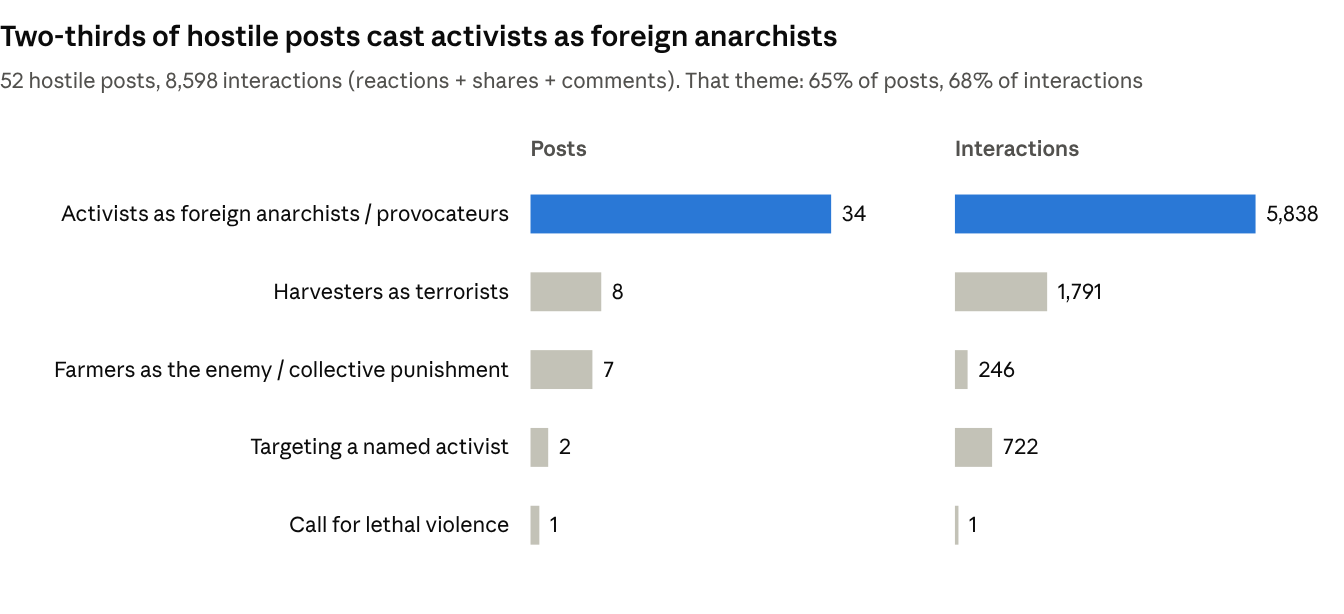
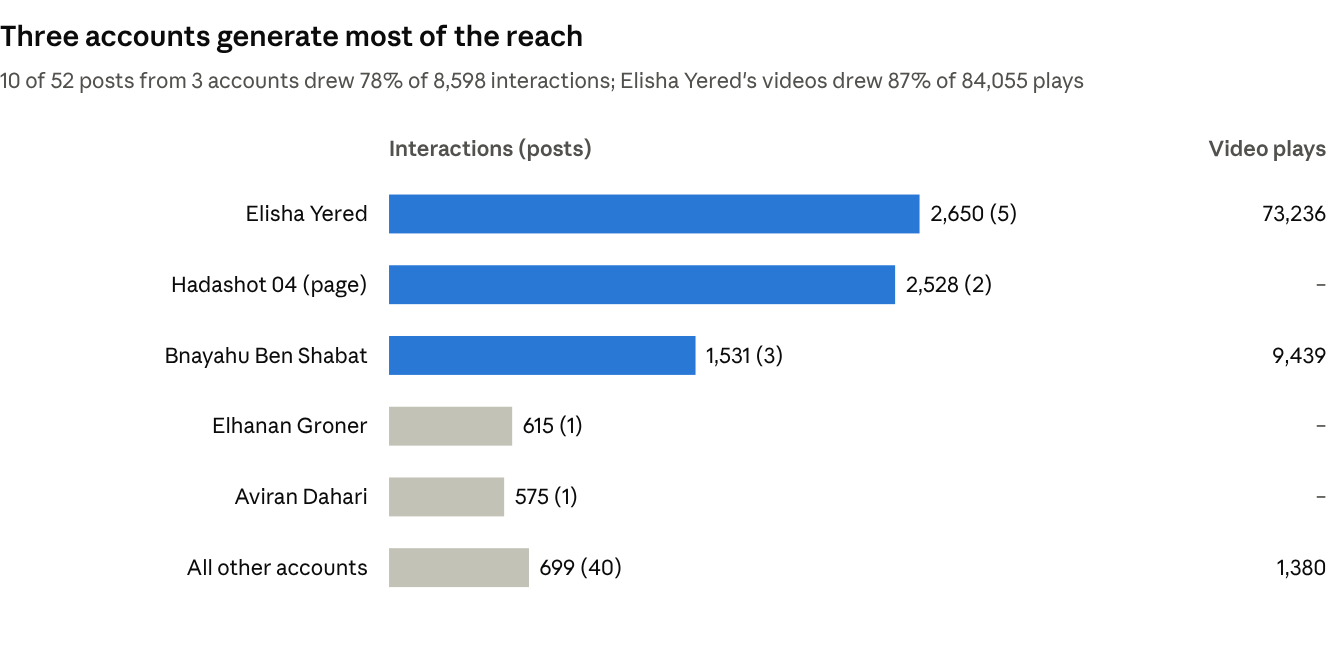
The report found that 34 posts in the sample described activists as foreign “anarchists” who stage “provocations”. This framing casts the people who document attacks and try to curb them as responsible for the attacks themselves. The sample also included 32 posts calling for activists to be deported, arrested or subjected to restrictions. The report found that reach and engagement were heavily concentrated among three accounts, which accounted for 78% of all interactions with the posts.
These narratives also circulated on WhatsApp, where the report documented their use in settler channels to mobilise against the olive harvest. One message called on the Israeli military to declare the harvesting area in the village of Deir Jarir a closed military zone. The circulation of posters was documented separately. They urged settlers to reach olive groves before Palestinian farmers and take steps to stop the harvest.
7amleh calls on Meta to remove without delay Hebrew-language content that incites against olive harvesters and solidarity activists, hold the accounts that publish it accountable, and apply its policies without double standards to content that dehumanises Palestinians and labels Palestinian farmers and villages as “terrorists” or “murderers”. 7amleh also calls on Meta to recognise the olive harvest season as a period of heightened risk for Palestinians in the West Bank and take proactive measures to prevent its platforms from being used to fuel settler violence.
Introduction
Across the occupied West Bank, including East Jerusalem, settlements have been at the core of Israel's colonial project since 1967. The project has advanced through continuous settlement construction and a steady growth in the number of Israeli settlers living on Palestinian land, at the direct expense of Palestinian communities. Land appropriation and settlement expansion have uprooted Palestinians from their homes and land, in a process that amounts to ethnic cleansing. In 2025 alone, 86 new outposts were established, and 22 Palestinian communities were fully or partially displaced.[1] In July 2024, the International Court of Justice found Israel's continued presence in the occupied territory unlawful, and ruled that Israel must "cease immediately all new settlement activities" and "evacuate all settlers".[2]
This process is backed and funded by the Israeli state. Settlers attack Palestinian communities, seize their land and establish outposts. The state then provides these outposts with security, infrastructure and services, and in many cases legalizes them over time. The UN High Commissioner for Human Rights has found that the line between settler and state violence has "blurred to a vanishing point", and that settler violence takes place "in a climate of continuing impunity".[3] The Israeli human rights organization B'Tselem describes settler violence as "a major informal tool" the state uses to take over Palestinian land.[4]
Emboldened by this support, settlers do not wait for the state to act. Many are ideologically driven and organized in groups such as the Hilltop Youth. The UK government sanctioned the group in 2024, describing it as "a hardline nationalist Israeli youth group which establishes illegal settler outposts across the West Bank", whose stated aim is to remove Palestinians from the occupied territory.[5] These groups carry out systematic attacks on Palestinian communities and lead settlement expansion on the ground.
This violence is not confined to the ground. Social media platforms, including Meta's, have allowed Hebrew-language incitement against Palestinians, by settlers and Israeli officials among others, to be published and spread. Online incitement now accompanies, and in some cases calls for, attacks on Palestinian communities. 7amleh has documented this pattern for years. In 2024 alone, its Violence Indicator flagged more than 2.5 million harmful Hebrew-language posts and comments, and its research has shown how Meta fails to protect Palestinians from such content while over-enforcing its rules against Palestinian voices.[6]
Every olive harvest season, Palestinian farmers in the occupied West Bank face a surge in settler violence, and in 2026 attacks on harvesters were reported almost daily.[7] This violence is accompanied by a parallel surge online: Hebrew-language content on Meta’s platforms that portrays Palestinian harvesters as “terrorists”, casts the Israeli and international activists who accompany them as foreign “anarchists” staging “provocations”, and calls for action against both.
In this report, 7amleh - The Arab Center for the Advancement of Social Media presents 52 Facebook posts that illustrate this trend, most of them published in the first two weeks of October 2026. The posts delegitimize, dehumanize or call for action against harvesters and activists, and all were publicly available when collected. They are a sample of a much wider phenomenon, not a full count. 7amleh has previously documented violent Hebrew-language speech against Palestinians on social media at a far larger scale.
- Protective presence recast as a threat. Two-thirds of the posts (34) describe solidarity activists as foreign "anarchists" staging "provocations". This framing turns people documenting violence into its cause. National Security Minister Itamar Ben-Gvir called for administrative detention to be used against them as "enemies of the state" [P9[8]].
- Farmers dehumanized. 16 posts describe Palestinian harvesters as terrorists or Palestinian farmers as "the enemy". One calls them "well-oiled arms of Hamas and the PA" [P4]. Another asks followers to agree that if a harvester is “an enemy”, disrupting him and taking his olives is “permitted, and a religious duty” [P15]. One calls for collective punishment, including uprooting a village's olive trees.
- An explicit call to kill. One post calls olive harvesters terrorists and says that “only live fire at them will stop and eliminate the phenomenon”.
- Reach is concentrated. Three accounts produced 10 of the 52 posts but generated 78% of their 8,598 interactions. One account's videos drew 87% of 84,055 video plays.
- Online targeting matched offline violence. Settler attacks or harvest obstruction were reported in 4 of the 5 Palestinian villages named in the posts. In Duma, a village a post called "the village of murderers", a further attack on harvesters was reported three days after the incident the post described.
- The same narratives also circulate in settler WhatsApp channels. One message there called on the army to declare a village’s announced harvest day a closed military zone in advance. Separately, posters circulated among settlers urged them to reach groves before Palestinian farmers arrived and stop the harvest.
Findings
1. Five hostile narratives
Most of the hostility targets the people who accompany farmers to their groves, not the farmers themselves. Protective presence, a long-standing practice that documents violence and deters it, is recast as a foreign-funded provocation.
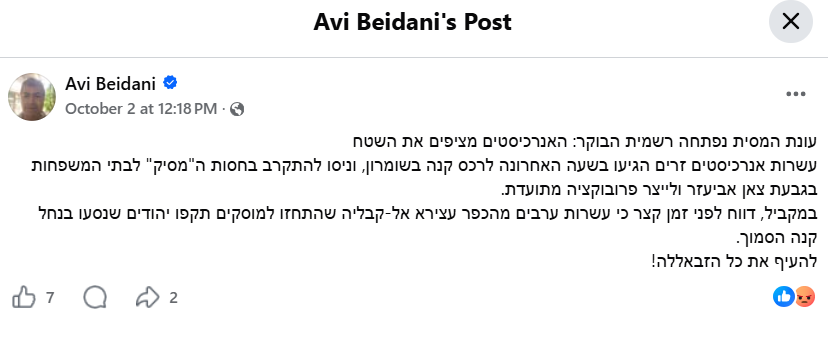
Activists as foreign "anarchists" (34 posts). Solidarity volunteers are described as an invading force that "floods" the area to stage confrontations for the cameras:
"The incitement season officially opened this morning: the anarchists are flooding the area Dozens of foreign anarchists arrived in the last hour at the Kana ridge in the Shomron, and tried, under cover of the "harvest", to approach the families' homes in Givat Tzan Aviezer and create a documented provocation. At the same time, it was reported a short while ago that dozens of Arabs from the village of Asira al-Qibliya, posing as harvesters, attacked Jews who were traveling in nearby Nahal Kana. Throw out all the garbage!." [P16]
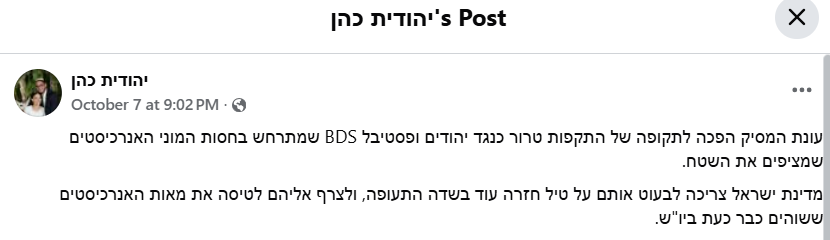
Others call for their removal from the country:
"The harvest season has become a period of terror attacks against Jews and a BDS festival under cover of the masses of anarchists flooding the area. The State of Israel should kick them back onto a plane at the airport, and add to the flight the hundreds of anarchists already staying in Judea and Samaria." [P17]
"Finally, it's about time!!! For years, left-wing activists and Israel-hating anarchists have come from abroad to set the area on fire, to confront and persecute IDF soldiers." [P20]
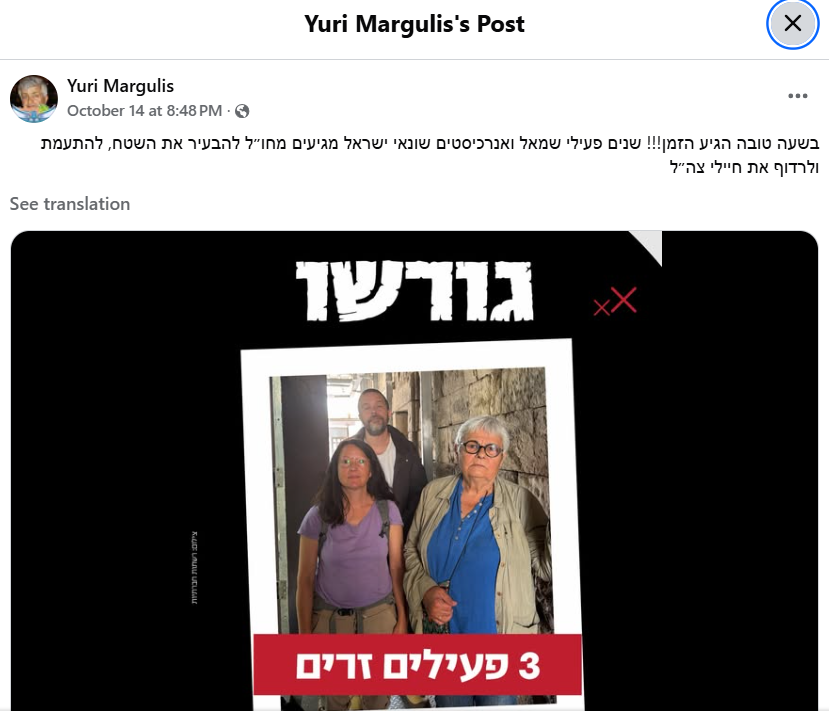
One widely copied message celebrated the arrest of "four foreign anarchists" and their referral for deportation [P10].
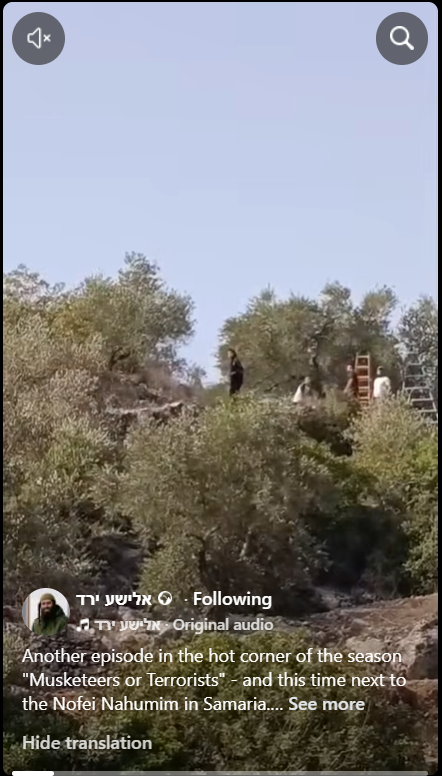
“At the opening of the harvest season: four foreign anarchists arrested and referred for deportation proceedings
Four foreign anarchists were detained on Friday near Kfar Tapuach in the Shomron and questioned on suspicion of disturbing order and being in a closed military zone. At the end of the questioning, the material was transferred to the Population and Immigration Authority for a hearing and a decision on their deportation from the country.
At the same time, the wave of attacks under cover of the harvest continues: shepherds and families were attacked, Jews were injured by stone-throwing, and property was damaged. Near Tapuach and Rehelim, a group of Jewish hikers was attacked. According to their testimonies, the attackers tried to snatch a boy of about 14 into the crowd. On Shabbat, a Jew from Tzan Aviezer was injured in the head and evacuated from the scene.
Shomron Regional Council head Yossi Dagan welcomed the arrests and the deportation review: "Whoever comes here to create provocations should know that there is a price for it."
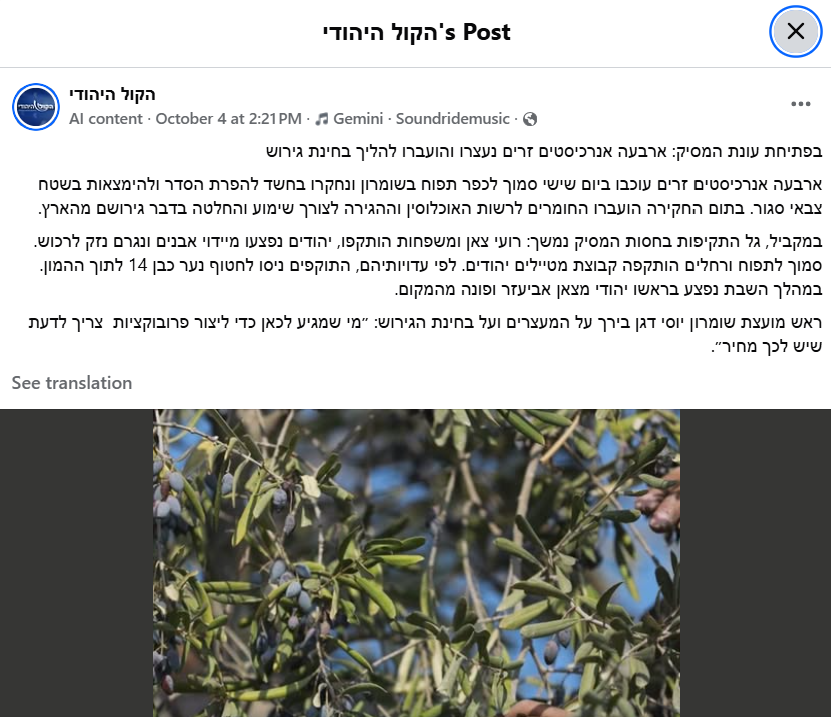
Harvesters as terrorists (8 posts). The harvest itself is presented as a cover for attacks and intelligence-gathering:
"The terror season has begun: a wave of attacks on Jews under cover of the harvest
Despite the many warnings, the harvest season opened with a wave of attacks on Jews across Judea and Samaria. Arabs and foreign anarchists approach settlements, farms and grazing areas under cover of the harvest, and in some cases attack and gather intelligence.
In the past two days, among other incidents:
• An ambush and attack on a shepherd near Beit Ur al-Tahta
• An attack on a family and a father with his children in the Har Bracha area
• An attempted lynching of hikers near Yasuf and an attempt to kidnap a 14-year-old boy
• Stone-throwing and an attempt to snatch a weapon at the Beit Karnayim farm
• Dummy explosive devices and booby-trapped Hamas flags placed in the Talmonim bloc and on the Allon road
• Attacks on shepherds near Adei Ad and at Givat Or Nachman
• Stone-throwing at Tzan Aviezer and Emek Doron, where a vehicle was damaged and a resident was threatened with a saw
• Confrontations between Arabs and anarchists and IDF forces near Tel Aroma
The names and patterns repeat every year, but the security establishment does not act in advance, and wakes up only when the rioters are already reaching the residents of the farms and hilltops.
To join HaKol HaYehudi updates on WhatsApp [link]." [P3]
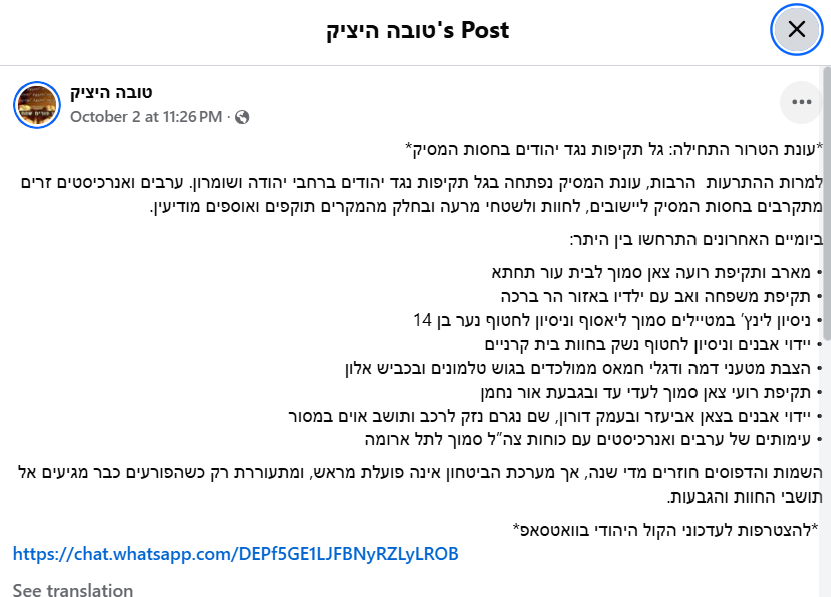
A recurring video series by settler activist Elisha Yered is titled "Harvesters or terrorists". One episode, filmed near the Nofei Nehemia settlement, tells viewers:
"Another episode in the season's hot segment, "Harvesters or terrorists" – this time near Nofei Nehemia in the Shomron. This isn't a harvest, it's improving a forward position for the next attack." [P1]
The same account told followers in advance how to treat reports of violence during the season:
"This coming Shabbat the season of violent provocations will reach its peak - with the official opening of the harvest in Binyamin and other sectors.
I'd like to believe otherwise, but this Shabbat there will probably be dozens of terror incidents and violent attacks in Judea and Samaria under cover of the harvest.
Stay alert, and of course take with a very large grain of salt any libel published in the left-wing media and on Arab networks.
Shabbat shalom and good news!." [P14]
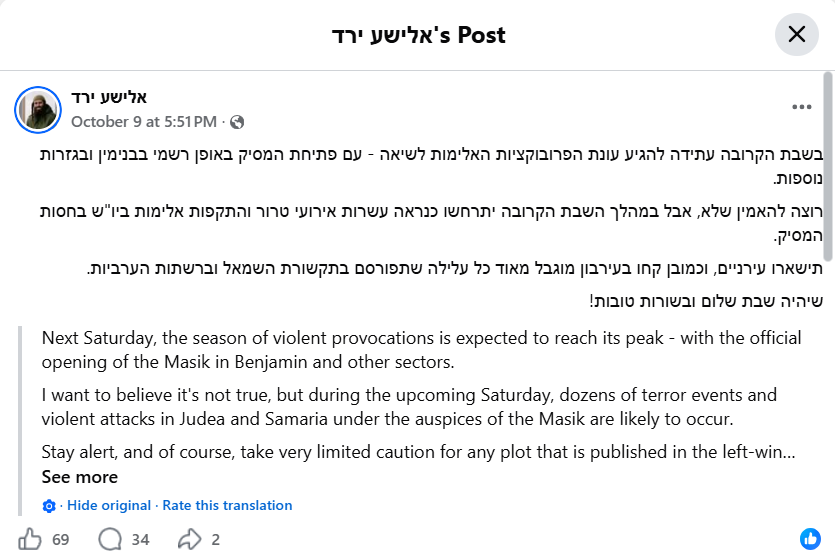
This kind of pre-emptive dismissal teaches audiences to disbelieve documented attacks on harvesters before they happen. A parallel post reports "a series of terror incidents in Judea and Samaria under cover of the Arab harvest" and urges followers to spread the claim themselves: "It's on you. You are the media. Share on social media, post it as a status" [P19]. Another post complains that "the army is not removing the enemy from the area nearly enough" [P18]. These 8 posts average about 220 interactions each, the highest of any narrative.
Farmers as "the enemy" (7 posts). Olive cultivation is described as a weapon of war, and Palestinian farmers as militants:
"Among people of the religious left in Gush Etzion, there has been a broad attempt in recent days to paint the Arab harvest as a purely humanitarian event – while we all know well that this is, in every sense, another chapter in the war the enemy is waging. An olive tree today is more significant in the campaign over Judea and Samaria than an M16 rifle. These have long not been Arab fellahin, but well-oiled arms of Hamas and the PA. There is no obligation to be ignorant. Before you start a discussion, just read this investigation by HaKol HaYehudi published two years ago, and you will understand what the little olive tree planted outside your home's window is." [P4]
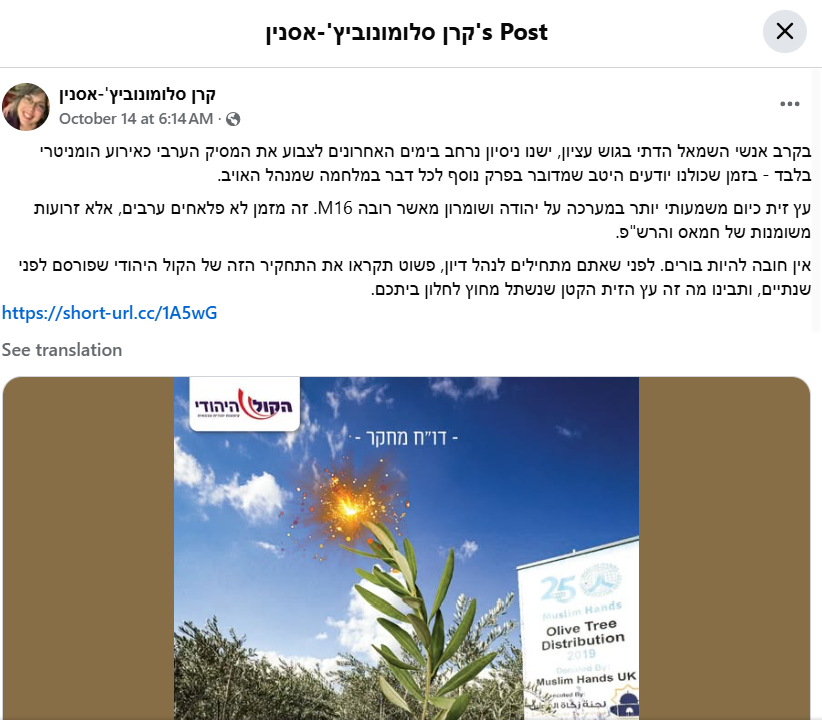
This framing is used to justify obstructing the harvest and taking the crop. One user put it to his followers as a question:
"OK, help me sort this out for a moment. Does everyone agree that if the Arab is an innocent harvester, there is no permission to touch his olive trees, and if the Arab is an enemy, and the whole purpose of growing the olives is to approach the settlements in order to restrict our movement and, when the order comes, to attack, then it is permitted, and a religious duty, to disrupt him as much as possible, including picking the olives for one’s own use? And then the whole argument is over the practical security question? Or are there other parts to discuss." [P15]
Another post calls for punishing whole villages through their trees:
"Collective punishments, closing Palestinian businesses in the village the terrorist came from for months! Uprooting olive trees in the village. Long collective closures." [P5]
Targeting named activists (2 posts). These posts single out individual Israeli activists by name as traitors:
"Meet Uri Gordon, a senior member of the group 'Anarchists Against the Wall'. Twelve days after 7/10, Uri stood with the Gazans against the State of Israel." [P13]
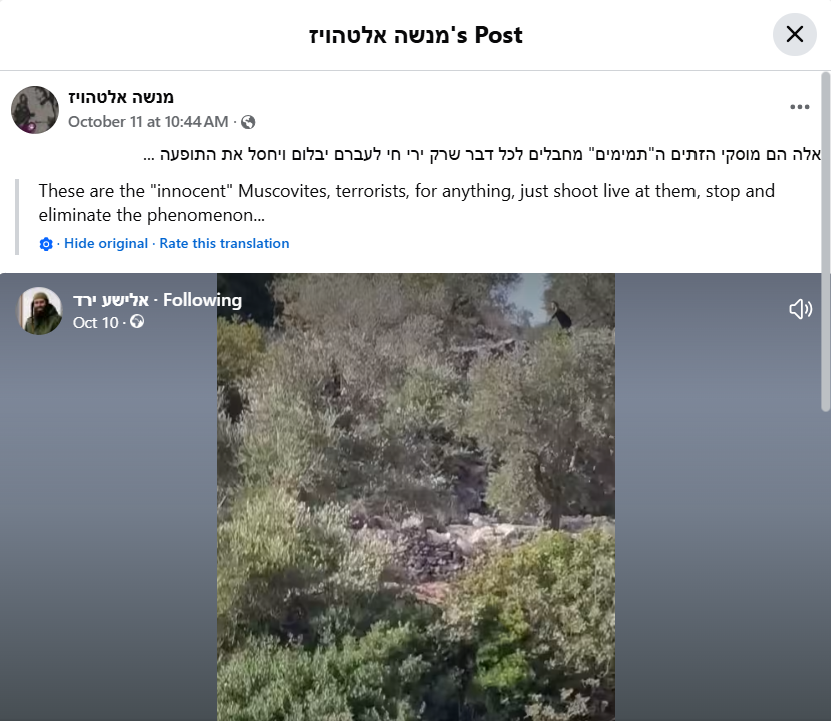
A call to kill (1 post). A private user wrote:
"These are the 'innocent' olive harvesters - terrorists in every respect, and only live fire at them will stop and eliminate the phenomenon." [P6]
Beyond Facebook: WhatsApp
This report focuses on public Facebook posts, but some of them point readers to closed channels. P3 ends with an invitation to join HaKol HaYehudi’s updates on WhatsApp, and P11 asks followers to join a group dedicated to “exposing” solidarity activists. These invitations show audiences being moved from public pages into private spaces, where content cannot be monitored and is not subject to Facebook’s moderation.
Messages circulating in settler WhatsApp channels show the same narratives used to mobilize against harvests. 7amleh obtained a screenshot of one such message, which falls outside the 52-post dataset:
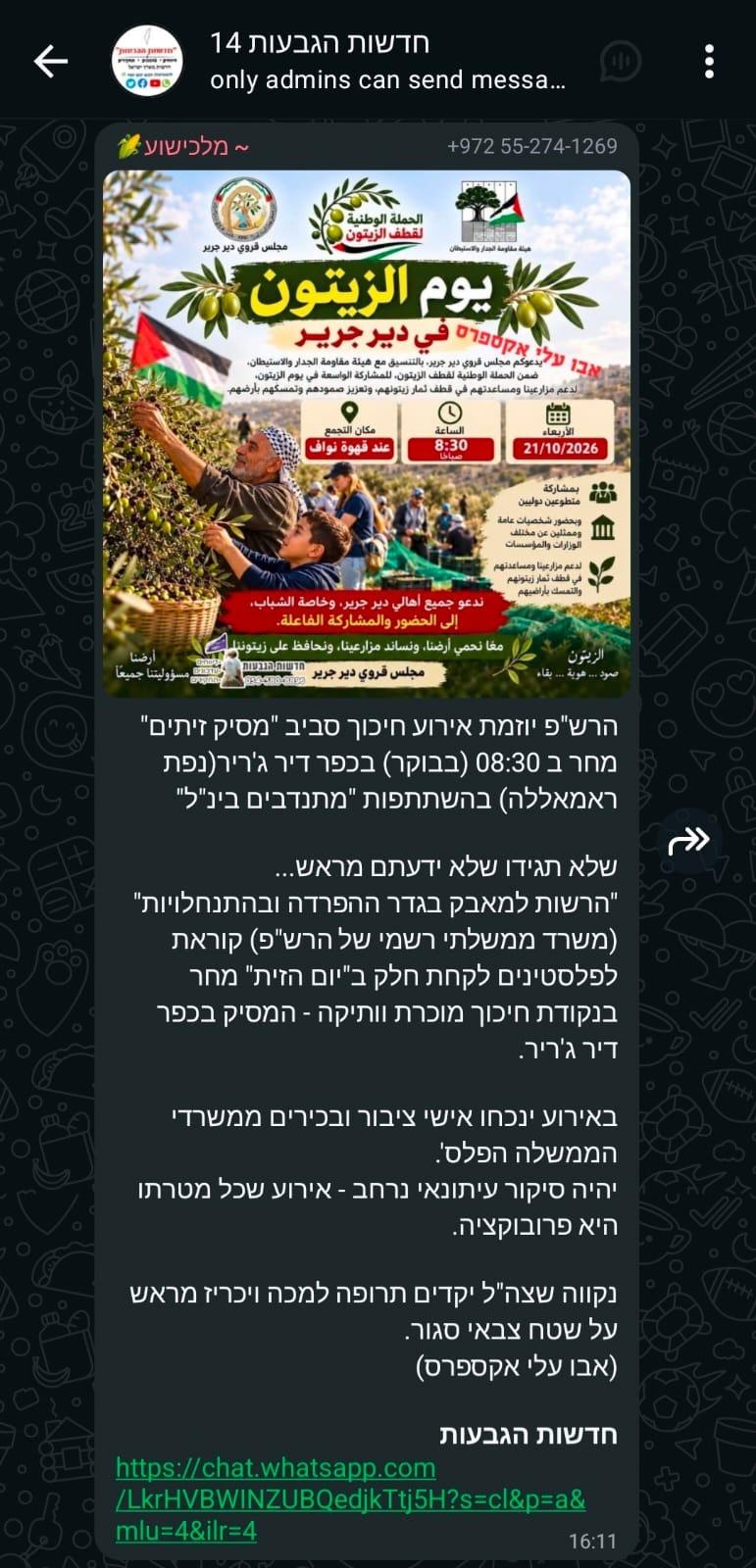
“The PA is initiating a friction event around an “olive harvest” tomorrow at 08:30 (in the morning) in the village of Deir Jarir (Ramallah district), with the participation of “international volunteers”.
So you can’t say you didn’t know in advance...
The “Colonization and Wall Resistance Commission” (an official government ministry of the PA) is calling on Palestinians to take part in “Olive Day” tomorrow at a well-known, long-standing friction point: the harvest in the village of Deir Jarir.
The event will be attended by public figures and senior officials from PA government ministries.
There will be extensive media coverage. An event whose whole purpose is a provocation.
We hope the IDF heads this off and declares a closed military zone in advance. (Abu Ali Express) Hilltop News“
Similar tactics have been documented elsewhere. The New Arab reported that posters circulated among settlers near the Gush Etzion settlement bloc. They urged settlers to reach groves near villages before Palestinian farmers were expected to arrive, and to stop the harvest.[9]
2. Calls to action
32 of the 52 posts (62%) ask for something to be done. Most demands ask the state to deport, arrest or restrict activists. Direct calls for violence are rare but present. The most senior voice is National Security Minister Itamar Ben-Gvir, in a statement shared by the Ofakim branch page of his party, Otzma Yehudit:
"Until today [the authorities] have not used these powers against the anarchists and against elements of anti-Zionist movements against the State of Israel. It is time to activate these tools against the enemies of the state." [P9]
|
Call |
Posts |
Example |
|---|---|---|
|
Rallying language ("time to wake up") |
18 |
"Through strategic planting, institutionalized violence and the help of foreign anarchists, a creeping takeover is taking place unhindered. It is time to wake up." (Olam Katan, excerpt of a column by Elisha Yered) [P8] |
|
Deport or bar foreign activists |
12 |
"The State of Israel should kick them back onto a plane at the airport" [P17] |
|
Arrest, punish or use state powers against activists |
12 |
"It is time to activate these tools against the enemies of the state" (Itamar Ben-Gvir, via Otzma Yehudit’s Ofakim branch) [P9] |
|
Expose or track activists |
5 |
"To support the continued exposure of the anarchists, join the activity group" [P11] |
|
Disrupt the harvest and take the olives |
1 |
“If the Arab is an enemy … it is permitted, and a religious duty, to disrupt him” (posed as a question to followers) [P15] |
|
Collective punishment, including uprooting olive trees |
1 |
"Collective punishments… uprooting olive trees in the village" [P5] |
|
Lethal violence |
1 |
"Only live fire at them will stop and eliminate the phenomenon" [P6] |
A post can contain more than one call, so the counts add up to more than 32. More often, the harvest itself is framed as "terror" or "provocation", so obstructing it reads as self-defense.
3. Reach: a few accounts set the narrative
The 52 posts generated 5,868 reactions, 879 shares and 1,851 comments, and their 10 videos were played 84,055 times. Most of this reach came from a handful of accounts with established audiences.
4. From posts to groves: named villages and reported attacks
Only 5 of the 52 posts name a Palestinian village: Duma (2 posts), Deir Istiya, Burin, Asira al-Qibliya and Zeita. Most posts locate the "threat" by region ("the Shomron", 24 posts) or by the nearby settlement: Kfar Tapuach, Emek Doron, Har Bracha, Nofei Nehemia and the Michtam LeDavid outpost. This places the activity mainly in the Nablus and Salfit governorates.
In 4 of the 5 named villages, press and monitoring reports document settler attacks or obstruction of the harvest during the same season.
|
Date (2026) |
Village |
Reported incident |
Source |
|---|---|---|---|
|
16 Oct |
Asira al-Qibliya |
Settlers attacked olive pickers. 3 people were injured and a vehicle set on fire. Troops then ordered the farmers off their land. |
|
|
16 Oct |
Deir Istiya |
Israeli forces detained two brothers picking olives in Wadi Qana |
|
|
16 Oct |
Burin |
Settler attacks on farmers |
|
|
15 Oct |
Duma, Burin, Asira al-Qibliya |
Settlers drove farmers from their land, chased them and stole crops |
|
|
12 Oct |
Duma |
Activists say a settler from the Michtam LeDavid outpost attacked Palestinian women harvesting olives. Police detained two Israeli volunteers, including Brig. Gen. (res.) Yoel Feldschuh. Settlers say the volunteers assaulted a teenage shepherd. |
|
|
Week of 6 Oct |
Deir Istiya |
Forces turned farmers away and confiscated ID cards and tools |
|
|
Early Oct |
Asira al-Qibliya |
Settlers under army protection assaulted farmers and solidarity activists. Tear gas set olive fields on fire. |
|
|
3 Oct |
Burin |
Settlers raided a grove and stole the olives and equipment. Troops fired tear gas, and 3 people were treated. |
|
|
2 Oct |
Deir Istiya |
Settlers and forces prevented farmers from harvesting in the town's western area |
|
|
29 Sep |
Deir Istiya |
Settlers under army protection blocked farmers from reaching their land |
Case study: Duma. On 12 October, a group of retired senior security officers and activists joined Palestinian farmers for the harvest on Duma's land. The activists say a settler from the nearby Michtam LeDavid outpost attacked Palestinian women carrying sacks of olives. Police detained two of the volunteers, including former Air Force intelligence chief Yoel Feldschuh.[10] A Facebook post about the incident described the outpost as lying "near the village of murderers, Duma", and claimed that "anarchists who came to the harvest provocation attacked a Jewish teen with a stick, punches and kicks" [P7]. Three days later, on 15 October, monitors reported that settlers again drove Duma's farmers from their land and stole their crops.[11]
Meta's responsibility
The olive harvest is a predictable, annual period of heightened risk. In the first weeks of the 2025 season, the UN Office for the Coordination of Humanitarian Affairs (OCHA) recorded 86 harvest-related settler attacks affecting 50 Palestinian villages and towns, up from 80 in 48 communities over the same period of 2024.[12] In 2026, Yesh Din counted 109 incidents of settler and soldier violence in roughly ten days from the start of the season.[13] Meta therefore had advance notice that Hebrew-language content targeting harvesters and the people protecting them would intensify between late September and November.
The content identified here falls under Meta's own rules:
- Violence and Incitement. Meta removes threats of violence that could lead to death, including calls for action and aspirational statements.[14]
- Hateful Conduct. Meta's Tier 1 rules prohibit content that targets people on the basis of protected characteristics, including ethnicity and national origin, with allegations that they are "violent criminals (including but not limited to: terrorists, murderers)".[15] Posts describing Palestinian harvesters collectively as terrorists, or a Palestinian village as "the village of murderers", fall within this rule.
- Targeting of human rights defenders. Solidarity activists accompanying farmers act as human rights defenders. Content that labels them foreign agents, calls for their deportation and invites followers to "expose" them coincides with official moves against them: in October 2026 the Defense Minister reportedly sought administrative exclusion orders against activists who help Palestinian harvesters.[16]
Meta has been warned before about gaps in its moderation of Hebrew content. The independent human rights due diligence report Meta commissioned from BSR after the events of May 2021 found that Meta had an Arabic hostile-speech classifier but no equivalent for Hebrew, and too few Arabic- and Hebrew-speaking reviewers.[17] 7amleh has worked intensively as well over years and exposed flaws in Meta’s moderation systems when it comes to Hebrew violent content targeting Palestinians.[18]
7amleh calls on Meta to:
- Remove, without delay, Hebrew-language incitement against Palestinian olive harvesters and solidarity activists, including explicit calls for violence, and hold the accounts spreading it accountable.
- Enforce its policies, without a double standard, against dehumanizing Hebrew content that labels Palestinian farmers and villages as “terrorists” and “murderers”.
- Recognize the olive harvest season as a period of heightened risk for Palestinians in the occupied West Bank, and adopt proactive measures to prevent its platforms from fueling settler violence.
Annex 1: Facebook Posts Cited
Posts are identified by account and Facebook post ID.
|
Ref |
Account |
Post ID |
|---|---|---|
|
P1 |
Elisha Yered |
1049748571428442 |
|
P2 |
Elisha Yered |
1051185467951419 |
|
P3 |
Tova Hayitzik (reposting HaKol HaYehudi) |
2668787583541029 |
|
P4 |
Keren Slomonovich-Asnin |
39251008291181212 |
|
P5 |
Omer Waldman-Patzniash |
122110716255460480 |
|
P6 |
Menashe Althoiz |
2126069838116915 |
|
P7 |
Eyal Paz |
122388772478007378 |
|
P8 |
Olam Katan (excerpt of a column by Elisha Yered) |
1723329526460651 |
|
P9 |
Otzma Yehudit, Ofakim branch (statement by Itamar Ben-Gvir) |
122236605884326725 |
|
P10 |
HaKol HaYehudi |
1693295902806124 |
|
P11 |
Bnayahu Ben Shabat |
122142931683348319 |
|
P12 |
Hadashot 04 |
1547321864094365 |
|
P13 |
Aviran Dahari |
28430984549888808 |
|
P14 |
Elisha Yered |
1048691571534142 |
|
P15 |
David Oren |
1082684054592904 |
|
P16 |
Avi Beidani |
10164011601666284 |
|
P17 |
Yehudit Cohen |
3163224447206217 |
|
P18 |
Elhanan Groner |
122127397221260524 |
|
P19 |
Racheli Lior |
28423553010671439 |
|
P20 |
Yuri Margulis |
10164774962669605 |
References
-
Peace Now. "Summary of a Year of Terror, Expulsion, and Annexation: Settlement Activity in 2025." 3 February 2026. ↑
-
International Court of Justice. Legal Consequences arising from the Policies and Practices of Israel in the Occupied Palestinian Territory, including East Jerusalem, Advisory Opinion, 19 July 2024. See UN summary. ↑
-
UN Office of the High Commissioner for Human Rights. Israeli settlements in the Occupied Palestinian Territory, including East Jerusalem, and in the occupied Syrian Golan (A/HRC/58/73). See "Israel ramps up settlement and annexation in West Bank with dire human rights consequences." 18 March 2025. ↑
-
B'Tselem. "State Business: Israel's misappropriation of land in the West Bank through settler violence." November 2021. ↑
-
Global Security. "UK sanctions extremist groups and individuals for settler violence in the West Bank." 3 May 2024. ↑
-
7amleh. "Meta's Role in Amplifying Harmful Content Against Palestinians During Genocide in Gaza." 2 September 2025. ↑
-
Al Jazeera. "Palestinians, US journalist attacked in West Bank pogrom: What we know" (citing Yesh Din via Reuters). 16 October 2026. ↑
-
References in the form [P#] refer to the posts listed in Annex 1. ↑
-
The New Arab (Agnese Boffano). “Israeli settlers mobilise to terrorise Palestinian olive harvesters.” 12 October 2026. ↑
-
Times of Israel. "Two left-wing activists and settler teen detained over West Bank clash during olive harvest." 12 October 2026. ↑
-
WAFA. "CWRC documents 21 Israeli attacks against farmers in 12 hours." 15 October 2026. ↑
-
UN OCHA. "Humanitarian Situation Update #333 | West Bank." 23 October 2025. ↑
-
Haaretz. "The IDF Must Allow Activists to Accompany West Bank Olive Harvests" (editorial, citing Yesh Din). 9 October 2026. ↑
-
Meta Transparency Center. “Violence and Incitement.” Community Standards. https://transparency.meta.com/policies/community-standards/violence-incitement ↑
-
Meta Transparency Center. “Hateful Conduct.” Community Standards. https://transparency.meta.com/policies/community-standards/hateful-conduct ↑
-
Times of Israel. "Katz reportedly seeking to ban pro-Palestinian activists from West Bank during olive harvest." 8 October 2026. ↑
-
BSR. "Human Rights Due Diligence of Meta's Impacts in Israel and Palestine in May 2021." 22 September 2022. ↑
-
7amleh. "7amleh Documents Over a Million Instances of Violent Speech in Hebrew Against Palestinians on Social Media Platforms." 14 November 2023. ↑
This version is licensed under the following International License: Attribution-NonCommercial-ShareAlike 4.0 International
To view a copy of the license, please visit the following link:
https://creativecommons.org/licenses/by-nc-sa/4.0
 Palestinian olive harvest