




Digital Rights Weekly Update: 24 - 30 April 2026
-

-

-

-

 !Copied
Policy Insight:
We are at a critical and deeply sobering moment for the future of human rights and digital rights globally. While this week’s developments show how our sustained efforts can yield results, from correcting digital erasure on mapping platforms to exposing how tech companies continue to enable and profit from settlement activity and violence, they also reveal the scale of the challenge ahead. Accountability remains urgent, as platforms continue to shape narratives, economies, and even geography in ways that directly impact Palestinian lives.
At the same time, the last-minute cancellation of RightsCon by the Zambian government is a serious attack on the global digital rights community. It sends a chilling signal about shrinking civic space and the growing resistance to accountability worldwide. Yet, this moment also underscores why this work matters. In solidarity with our colleagues across the movement, we remain committed. When the moment is difficult, the work becomes more necessary. We persevere, because we are fully aware safeguarding digital rights is not privilege, it is fundamental.
News Digest
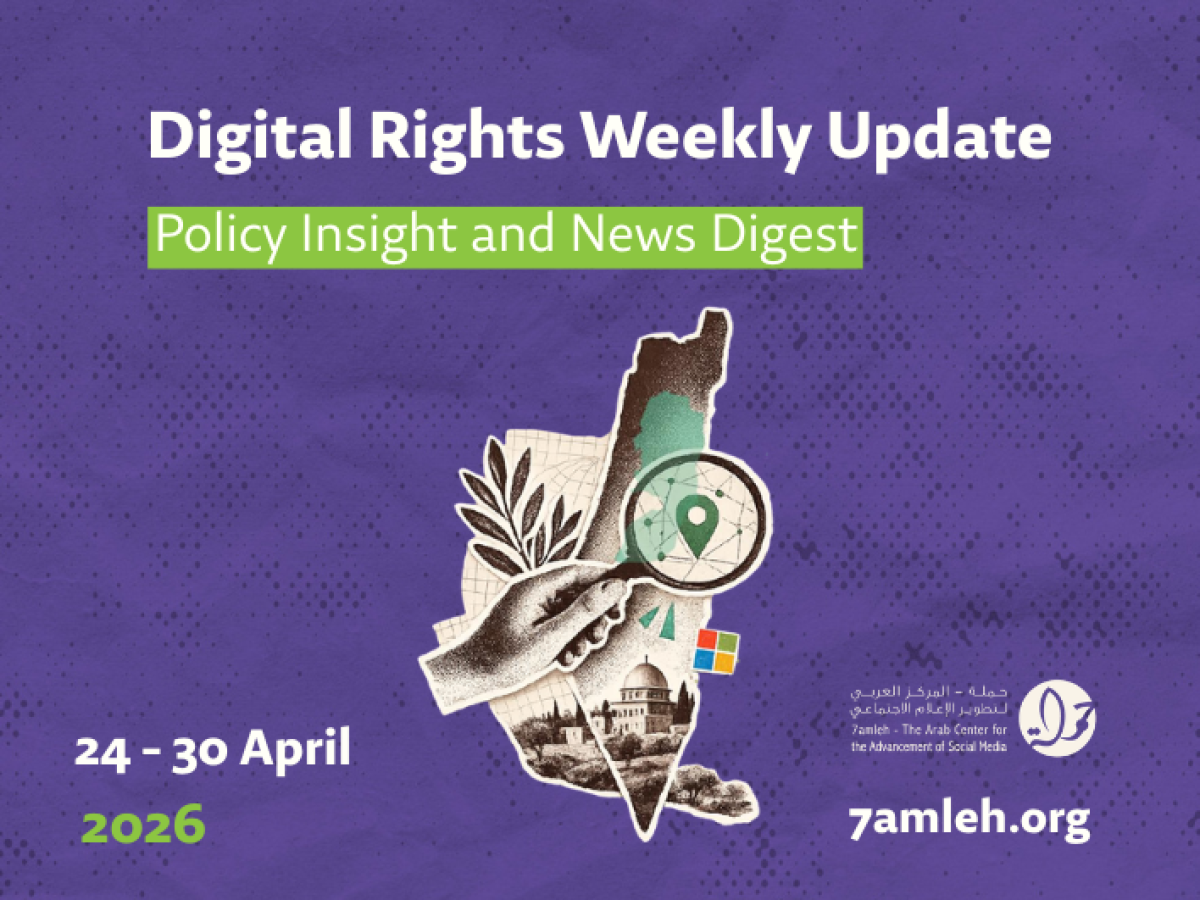
7amleh Secures Inclusion of Palestinian Geographic Terminology Across Microsoft Platforms Maps
7amleh
April 27, 2026, 7amleh - The Arab Center for the Advancement of Social Media confirms that recent changes across Microsoft platforms' maps have ensured the inclusion of Palestinian geographic references and the removal of a number of false and misleading Israeli labels that had been imposed in the occupied West Bank. This matters all the more at a time when Israel is accelerating de facto annexation across the occupied West Bank while intensifying settler violence and forced displacement, which amount to ethnic cleansing. In this context, the way digital systems classify Palestinian places cannot be treated as incidental. Such classifications can reinforce the erasure of the Palestinian geography and normalize unlawful Israeli claims over the occupied territory. Following months of documentation, direct engagement, and sustained pressure, 7amleh succeeded in compelling changes across Microsoft platforms.
Microsoft includes Palestinian geographic terminology in its maps, removes Israeli designations: Report
AA
Microsoft has made changes to its digital maps to include Palestinian geographical names and removed some “misleading” Israeli designations used in the occupied West Bank, a digital rights group said Monday. In a statement, the Arab Center for the Advancement of Social Media (7amleh) said the changes include location-based services, including the search engine “Bing,” where labels that previously listed locations in the West Bank under “Judea and Samaria, Israel” were replaced with the term “West Bank.” "Judea and Samaria" is an Israeli term to designate the occupied West Bank. However, under international law, the West Bank, including East Jerusalem, is regarded as Israeli-occupied Palestinian territory and a key component of a future Palestinian state. The changes represent a “necessary correction,” said Lama Nazeeh, 7amleh's advocacy manager, calling on technology companies to comply with international law and not contribute to the “digital erasure of Palestinian geography.” An Anadolu search on the Bing map also confirmed that the name West Bank has been adopted by Microsoft to refer to the Palestinian territory.
Google and Meta run thousands of ads promoting West Bank settlement businesses
The New Humanitarian
The New Humanitarian cross-referenced both tech-giants’ ad libraries with a UN human rights office database listing 158 firms involved in construction, demolition, surveillance, resource extraction, and pollution in the occupied Palestinian territory. Of these, 39 firms purchased ad space from Google and Meta after they were added to the UN list. Another three firms bought ads before they were listed. At least seven of these businesses recently promoted products and services directly related to settlement, including housing, an expedited gun license programme, and machinery used in the demolition of Palestinian property. Other firms’ ads are less explicitly tied to settlement. Israel’s national water company, Mekorot, has advertised infrastructure projects that span both Israel and occupied areas. The accommodation platforms Booking.com, Airbnb, and Tripadvisor – all listed by the UN for “supporting the maintenance and existence of settlements” – account for most of the ads.
EFF warns UN of systematic killings and digital isolation targeting Palestinian journalists since October 2023
Cambridge Analytica
The Electronic Frontier Foundation has filed a formal submission to the United Nations documenting a documented deterioration in press freedom and digital rights for Palestinian journalists and media workers since October 2023, marking what the digital rights group calls a “significant” escalation in both physical attacks and systematic online censorship. The submission, made to the UN Special Rapporteur on the situation of human rights in the Palestinian territories occupied since 1967, arrives as the UN itself launched a study addressing three specific harms: the killings and attacks against Palestinian journalists and media workers, the destruction of media infrastructure in Gaza, and the production and dissemination of narratives that may enable, justify, or incite international crimes. The EFF’s briefing identifies three concrete mechanisms of digital control that have intensified since October 2023. The first involves government takedown requests—official demands to remove content from platforms. The second centers on disinformation and content moderation practices, where the group flags concerns about how platforms themselves decide what Palestinians can see and share. The third targets attacks on internet infrastructure itself, the physical and digital systems that allow Palestinians to connect to the broader internet at all.
Making Israel's Case to ChatGPT and Grok: Hasbara Meets AI in Multi-million Dollar PR Push
Haaretz
The Electronic Frontier Foundation has filed a formal submission to the United Nations documenting a documented deterioration in press freedom and digital rights for Palestinian journalists and media workers since October 2023, marking what the digital rights group calls a “significant” escalation in both physical attacks and systematic online censorship. The submission, made to the UN Special Rapporteur on the situation of human rights in the Palestinian territories occupied since 1967, arrives as the UN itself launched a study addressing three specific harms: the killings and attacks against Palestinian journalists and media workers, the destruction of media infrastructure in Gaza, and the production and dissemination of narratives that may enable, justify, or incite international crimes. The EFF’s briefing identifies three concrete mechanisms of digital control that have intensified since October 2023. The first involves government takedown requests—official demands to remove content from platforms. The second centers on disinformation and content moderation practices, where the group flags concerns about how platforms themselves decide what Palestinians can see and share. The third targets attacks on internet infrastructure itself, the physical and digital systems that allow Palestinians to connect to the broader internet at all.
RightsCon Canceled After Zambia Requires ‘Full Alignment’ With 'National Values'
Tech Policy Press
RightsCon, a global conference of thousands of advocates, technologists, academics, policymakers and others concerned with issues at the intersection of human rights and technology, was scheduled to kick off in Lusaka, Zambia, on May 5. But with just days remaining and with many participants already en route, Zambian government officials announced they would postpone the conference in order to “ensure full alignment with Zambia’s national values, policy priorities, and broader public interest considerations.” On Wednesday, after attempting to negotiate a solution, RightsCon organizers announced the event would “not proceed.” “We do not recommend registered participants travel to Lusaka for RightsCon,” the announcement said. As recently as last month, Zambia’s Ministry of Technology and Science indicated preparations were on track. In a post on the ministry’s website, a government official welcomed the event and emphasized “its alignment with Zambia’s national development agenda.” Pictures depicted RightsCon director Nikki Gladstone briefing government officials along with Richard Mulonga, chief executive officer of Bloggers of Zambia, an organization that campaigns for digital rights and free expression that served as a local civil society partner to the RightsCon organizers.
 Digital
Related Articles


Subscribe to Our Email Alerts
And stay updated with our latest activities, news, and publications!
