

 !Copied
Policy Insight
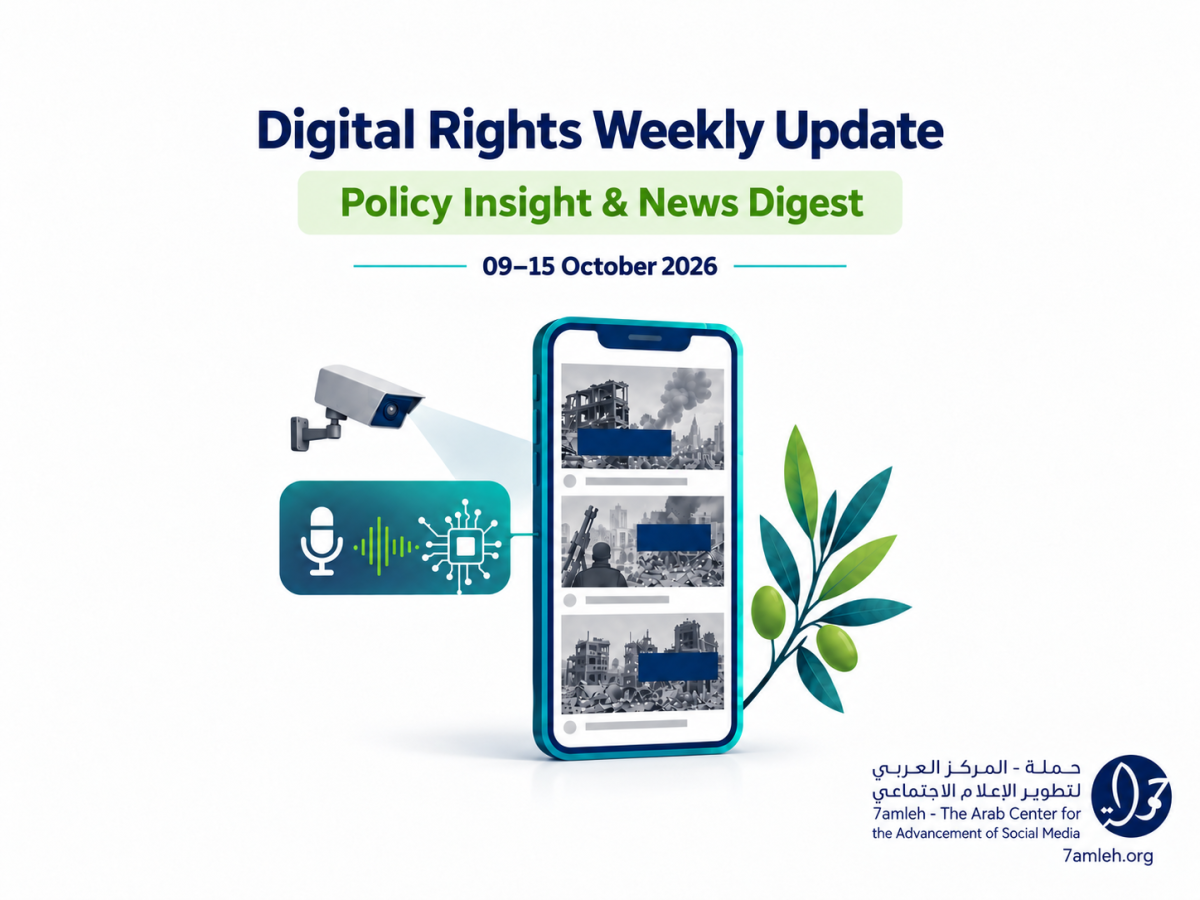
This week’s stories expose how digital infrastructure is increasingly used to organise settler-colonial violence, suppress Palestinian testimony and extend surveillance into everyday life. As the annual olive harvest begins, a period when Palestinians across the occupied West Bank face heightened settler violence while accessing their land, WhatsApp groups are helping settlers coordinate attacks against Palestinians. Platforms must be held accountable when their services facilitate the organisation of this violence.
Meta’s closure of journalist Anas Al-Sharif’s account raises urgent concerns about the erasure of an archive documenting three years of genocide and the loss of potential war crimes evidence. Meta must explain its decision, restore the archive and protect documentation essential to accountability. The UN Special Rapporteur’s report, Truth Under the Rubble, further strengthens the case for holding media institutions and digital platforms accountable for suppressing Palestinian realities.
Last but not least, plans to monitor Gaza classrooms using AI threaten children’s privacy, expression and fundamental rights. These cases demand independent oversight, enforceable human rights safeguards and corporate accountability. At 7amleh, we will continue documenting how technology facilitates violations and producing the evidence needed to challenge those responsible.
News Digest
From Settler Colonialism and the Remote-Control Occupation: Tech-Innovation, Neoliberal Zionism, and Digital Sumūd in Times of Genocide
7amleh
7amleh has published a research paper by Arees Bishara, part of the volume Digital Domination: AI, Surveillance, and Digital Power in Palestine and Beyond, produced with the Ibrahim Abu-Lughod Institute of International Studies at Birzeit University. The paper argues that since October 2023 Israeli control has shifted towards algorithmic governance, biometric surveillance and AI-assisted targeting, a "remote-control occupation" that extends settler-colonial rule rather than replacing it. It identifies three linked forms of digital elimination: physical, through systems such as Lavender, The Gospel and the Blue Wolf and Red Wolf facial recognition tools; economic, through the integration of military research into global markets and Project Nimbus-style cloud contracts; and epistemic, through platform censorship and the destruction of archives and universities.
Israeli settlers mobilise via WhatsApp to terrorise Palestinian olive harvest
The New Arab
Israeli settlers gathered near Neve Daniel, in the Gush Etzion settlement bloc south of Jerusalem, on Monday to block Palestinian farmers from reaching their olive groves, following a call circulated in settler WhatsApp groups. A "Stop the Harvest" poster shared online told participants to arrive at 6:15am, ahead of the farmers' expected 6:30am arrival, and to bring water, hats and Israeli flags. Footage showed settlers trying to block Palestinians from their land and arguing with soldiers, journalists and activists. The Palestinian Colonisation and Wall Resistance Commission recorded at least 19 settler attacks across the West Bank by midday the previous Friday, including assaults on harvesters and crop theft. Activist and journalist Sam Avraham said "there certainly will be more calls like this" ahead of Israel's 27 October elections, as messaging platforms continue to be used to organise violence against Palestinians.
Meta shuts down Instagram account of slain Gaza journalist Anas Al-Sharif, erasing archive of his war reporting
The Siasat Daily
Meta has shut down the Instagram account of Anas Al-Sharif, the Al Jazeera correspondent from northern Gaza who was killed on 10 August 2025 when an Israeli strike hit a tent used by journalists near Al-Shifa Hospital. A statement posted on his X account on Friday, 9 October, said the team was deeply saddened to find the page closed, noting that it held his full archive documenting the war, and appealed to anyone with a channel to Meta or Instagram management to help restore it. Followers were directed to a backup account. The statement gave no reason for the closure and did not say whether Meta had offered an explanation; the company has not commented publicly.
UN Special Rapporteur's report "Truth under the rubble" names Meta, Google, X and TikTok in Gaza "mediacide"
United Nations
UN Special Rapporteur Francesca Albanese's report to the 81st session of the General Assembly examines how, in her words, the destruction of truth has become integral to the destruction of a people. Alongside the killing of journalists and criticism of outlets including the BBC, The New York Times, CNN and ZDF, the report turns to digital platforms, naming Meta, Alphabet, X and TikTok for unequal treatment of Palestinian and Israeli content through takedowns, account suspensions, reduced reach and shadow-banning. It cites Meta compliance of about 94% with removal or restriction requests concerning Israel and Palestine, TikTok compliance of 99.2% with Israeli requests, and some 38.8 million posts removed or restricted on Facebook and Instagram since late 2023, alongside a 77% drop in engagement with Palestinian news outlets. It also says platforms profited from around $50 million in Israeli government ad campaigns, singling out Google for keeping ads that disputed famine in Gaza.
US charity plans to use AI to monitor its Gaza classrooms for "hateful" speech
Associated Press
Gaza Children Village, a US charity that runs the Academies of Hope schools in Gaza, plans to record classroom conversations and use an AI-powered system to flag language it deems antisemitic, inciting or hateful. Founder and CEO Dr. David Hasan, a neurosurgeon who teaches at Duke University's medical school, told a webinar last month that alerts would come to him so he could contact teachers for context and feedback, with recordings kept for 72 hours. "I know it's controversial, but trust me, it's the only way we feel for us to survive and deliver this curriculum," he said. It is unclear when monitoring will begin, what language will be flagged, or whether teachers, students and families have been informed. Board member Bishara Bahbah said the plan had not been raised with the board and that "cameras to silence students and teachers from being able to have a free exchange in a classroom are not acceptable," while an official at a partner aid group warned it opens a "Pandora's box."
 Digital rights